

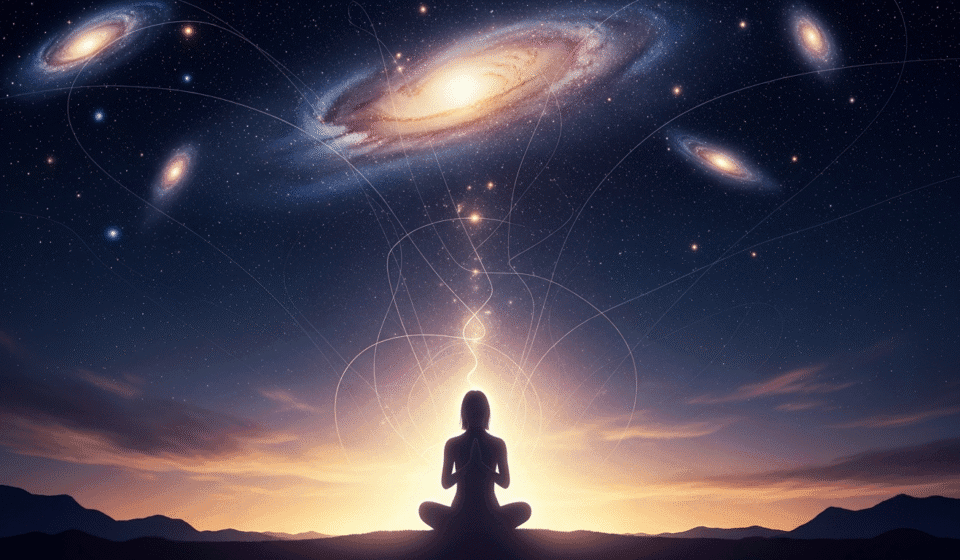
Where the human soul meets the whole of the universe

The Universal Human Gesture
There is a moment—ancient as the first dawn—when every human being, regardless of creed or culture, lifts their eyes upward. In joy, in despair, in awe, in trembling fear… the gaze rises. Even the atheist, in the crack of crisis, looks skyward. Even the skeptic, upon encountering beauty too vast for thought, instinctively tilts the head toward the heavens.
Why Do Humans Look Up?
Is this merely an evolutionary gesture from ancestors who once scanned the skies for storms and stars?
Or is it a deeper memory carved into our biological clay—a whisper from the universe reminding us of where we came from?
In this simple act of lifting the gaze, Intuidom finds its first point of inquiry:
the secret, sacred, and enduring relationship between the human being and the cosmos.
The Elemental Bond: The Universe Within
Science teaches us that we are made of hydrogen born near the dawn of time, carbon forged in the bellies of ancient stars, and calcium minted in the violent hearts of supernovae. The iron in our blood was once the core of a dying star. The oxygen we breathe came through cosmic cycles of creation and decay. The water that sustains us is older than the Earth itself.
We are, quite literally, the universe gathered into human form.
Returning to Our Origins
To look upward, then, is to return—if only for a breath—to our cosmic origin.
The upward gaze becomes a biological memory, a quiet recognition:
“I am of this vastness. I belong to this expanse. I am made of the same light.”
Intuidom’s First Truth
This is Intuidom’s first truth:
The universe is not only around us; it is also within us. Not only chemically, but psychically and intuitively.
Human consciousness is its own universe—a landscape of impressions, intuitions, dreams, symbols, longings, and spiritual tensions that refuse to disappear. Every civilization that has walked the earth sensed that the cosmos is not a mere machine of matter but a manuscript of mystery.
The ancient East called it Brahman. The West called it Logos. The Greeks called it Nous. Modern physics calls it space-time.
But to the human soul, it has always been something more:
a presence, a pulse, a whisper.
The Persistent Upward Gaze
And so the upward gaze persists, even in an age of satellites and particle colliders.
It is not just the neck rising—it is the soul stretching.
Intuition: The Inner Telescope
Here emerges Intuidom’s second truth: Reason measures the cosmos; intuition experiences it.
Intuition arrives as quiet signals—images, feelings, sudden recognitions.
Reason demands clarity, sequence, and proof.
Integrating Intuition and Reason
To make reason understand the intuitive flow of knowledge, the mind must first slow down and receive these subtle impressions without judgment. Then comes the translation: forming thoughtful concepts, testing them against lived experience, and letting the intuitive become intelligible.
This navigable movement—from interior insight to reflective understanding—is the core of Intuidom:
a disciplined harmony in which reason does not silence intuition, and intuition does not bypass reason.
The Need for Methodologies
Together, they create a fuller, more luminous way of knowing.
But this harmony requires methodologies psychological, biological, and physiological pathways capable of bridging inner knowing with outer understanding. A few attempts exist, but much remains to be done before knowledge from within and knowledge from without stand united.
Intuidom seeks to illuminate this convergence—the meeting point where intuition touches the infinite.
Why Differences Persist
If humans share an elemental and intuitive bond with the universe, why do our philosophies, religions, and worldviews differ?
Why does one person see the sky as divine canopy while another sees only physics?
Intuition Is Universal; Interpretation Is Individual
Because intuition is universal—interpretation is individual.
The mind interprets.
The soul intuits.
Culture, memory, intellect, fear, ego, language—these filter the universal through different lenses. The universe speaks in many tongues. Some hear mathematics. Some hear poetry. Some hear silence. Some hear God.
Two people may stand beneath the same stars and see two completely different heavens.
These differences are not failures—they are the universe thinking through us in countless forms.
Diversity of perspective is cosmic richness, not cosmic contradiction.
What Intuidom Stands For
Intuidom emerges as a bridge:
- between the intuitive East and the rational West,
- between the inner cosmos and the outer universe,
- between subjective spiritualism and objective science,
- between ancestral instinct and the modern analytical mind.
It is a home for those who feel that thinking alone cannot grasp truth, and intuition alone cannot express it.
A place where intellect bows to wonder, and intuition rises into clarity.
A sanctuary where the upward gaze is not an act of desperation—but an act of awakening.
Invitation to the Intuidom Journey
This first Intuidom editorial stands as an invitation:
Lift your eyes. Lift your mind.
Lift your inner universe.
For in the act of looking upward—whether toward the literal stars or the inner sky of intuition—you enter the oldest dialogue in existence:
the dialogue between the human soul and the universe that shaped it.
The Beginning of Intuidom
Here begins Intuidom’s journey. Here begins the fusion of ecstasy and reason, intuition and thought, human and cosmos.
Welcome to Intuidom—
a sanctuary for the upward gaze.

Powerful piece—makes you see the universe within ourselves and feel the pull of intuition alongside reason.
Thanks for your comment, and I look forward to your suggestions.
They say our souls are older than our matter, they realise it only when something as a part of their souls converges the human’s net focus level to a medium where feelings say everything, apart from time, apart from space.
Thanks for your comment, and I look forward to your suggestions.