

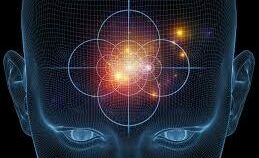
Unlocking Reality Through Human Intuition

An intuidom Editorial
By Nasir Gill
The Most Powerful Instrument for Knowing Reality
What if the most powerful instrument for knowing ultimate reality is not a telescope, a particle collider, or even a formal proof—but the disciplined interior life of a conscious self?
Intuition in the Age of Data
In an age obsessed with data and computation, “intuition” is often dismissed as a soft word for guesswork. At best, it is celebrated in business books as a mysterious faculty of quick decision-making. At worst, it is treated as a polite term for bias. Yet buried in that neglected word is a radical possibility: that human beings possess a genuine, though fallible, mode of cognitive access to the deepest structure of reality—including what religious traditions call God.
Starting from the Conscious Self
To take this seriously, we have to shift our starting point. Instead of beginning with an impersonal universe and asking how consciousness “emerges,” start where each of us actually lives: with the experience of being a conscious self.
Before we know quarks or galaxies, we know that we are aware. The first undeniable fact is not a set of equations but the simple, inescapable “I am, I experience.” Everything else—the external world, other minds, scientific laws—is encountered and interpreted through this primary light. Any philosophy that forgets this quietly saws off the very branch it sits on.
The Nature of Intuition
From this vantage point, intuition appears in a new light. Consider some of your most important moments of knowing. The instant you saw an act of cruelty and knew—before analysis—that it was wrong. The first time you recognized, with a kind of shock, the full dignity of another person. The strange stillness in which a piece of music, a night sky, or an unexpected silence seemed to disclose a depth in reality itself.
These are not the end-products of a chain of syllogisms. They arrive as direct perceptions of meaning and value. They have the feel of “just seeing” something important, even if we later unpack or question them. That is what I mean by intuition: a non-inferential awareness of reality’s significance—especially in the domains of value, personhood, and, at its farthest reach, the divine.
Intuition and Reason
This need not be mystification. Our entire rational edifice quietly rests on such intuitive givens. We do not prove that truth is better than falsehood, that other minds exist, or that the world is not a total illusion; we see these as more credible than their denial. Science itself is saturated with intuition: the sense of elegance in a theory, the “this must be right” guiding a good hypothesis, the moral conviction that knowledge is worth pursuing and sharing.
In other words, intuition is not the enemy of reason; it is its condition. Reason clarifies, tests, and systematizes—but it cannot generate its own first lights.
Cross-Cultural Perspectives
Across cultures, we find more intense versions of this direct seeing. Sufi mystics speak of kashf, the “unveiling” of the Real; Indian philosophers of anubhava, direct realization; Buddhists of prajñā, liberating insight; Christian contemplatives of infused knowledge. Their doctrines diverge, but structurally their testimonies agree: at times, reality discloses itself not as an object to be manipulated, but as a presence that addresses and transforms the self.
Iqbal’s Vision of the Ego
The poet-philosopher Muhammad Iqbal placed such experiences at the heart of his reconstruction of religious thought. For him, the ego (khudi) does not escape itself by dissolving into an impersonal Absolute; rather, it deepens itself through a living encounter with a greater Ego, God, in love and action. Whatever one makes of Iqbal’s specific theology, his core insight is harder to ignore: the highest knowledge of the Real is not achieved by spectatorship alone, but by a self entering into relation with what transcends it.
The Task of Intuidom
Intuidom exists in the space opened by this insight. We know that many things we feel are “obviously true, ” but some are nothing more than prejudice, fear, or wishful thinking. The mere sense of humor immediacy is not a guarantee of contact with the divine; it is also the hallmark of fanaticism.
The task, then, is not to choose between cynical dismissal and naïve embrace. It is to treat intuition as we treat any other cognitive faculty: as potentially revelatory, but in need of discipline and critique.
Discipline of Intuition
What might that discipline look like?
First, moral and psychological work. The more a person is tangled in self-deception, resentment, or the hunger for the superiority, the more their “intuitions” will mirror those distortions. Traditions that take intuition seriously—mystical, philosophical, or contemplative—typically insist on purification: honesty with oneself, acknowledgment of bias, practices that loosen the grip of egoic fantasies.
Second, integration with reason and experience. Authentic intuition does not bypass the world; it sends you back into it with clearer eyes. An “insight” that collapses when confronted with sustained argument or stubborn facts is more likely projection than perception. A living intuition, by contrast, invites articulation, welcomes critique, and grows in nuance over time.
Third, intersubjective testing. If there is such a thing as human access to the divine, we should expect at least partial convergence across cultures and eras, especially at the level of ethical and existential insight: the inviolability of persons, the destructiveness of cruelty, the transformative power of compassion, the suspicion that reality is not exhausted by what we can measure. Where purer streams of religious, philosophical, and secular moral reflection meet, we may be hearing not just the echo of our species, but the resonance of something deeper speaking through it.
Consciousness as a Fundamental Reality
Underlying all this is a bolder metaphysical claim that deserves open debate: that consciousness is not an accidental latecomer in a dead universe, but a fundamental aspect of reality. On this view, human selves are finite but real centers in a larger field of consciousness. Call that field reality , the Absolute, or simply the universal mind. The label matters less than the structure: the self is not an illusion to be erased, but a luminous node through which the whole becomes uniquely aware of itself.
In such a universe, intuition becomes more than a quirky psychological feature. It is one of the ways in which the ground of reality “presses through” into finite minds. And ethics ceases to be mere convention: if each self is a real center of this conscious field, then honoring, nurturing, and refusing to instrumentalize persons is not just decency—it is alignment with the way things most deeply are.
Man as the Measure
Taking “man as the measure” in this sense is not an act of arrogance. It is an admission that we cannot step outside our humanity to access a God’s-eye view. Our only tools are human: perception, reason, imagination, and yes, intuition. But to recognize their limits is not to deny their reach. The same consciousness that doubts and analyzes is also capable, at its best, of glimpsing a reality that grounds and exceeds it.
The Challenge and Opportunity
For a platform like Intuidom, the challenge and the opportunity are clear. We are not here to canonize every inner whisper as divine, nor to sneer at the very idea of immediate insight. Our task is more demanding: to cultivate a culture in which intuition is taken seriously enough to be trained, questioned, tested, and refined.
If human beings truly are finite windows into a universal consciousness, then the work of clarifying what we “see” there—and learning to trust it without closing our eyes—is not a private luxury. It is a public responsibility, and perhaps the most urgent philosophical project of our time.


Show CommentsIt is an interesting work
Thanks for your comment and I look forward for your suggestions to improve.
Nice.
Excellent work synthesizing complex ideas, and your passion for it clearly comes through.
Thanks for your comment and I look forward for your suggestions to improve.