

The Heart Knows What the Mind Cannot: The Faith, Intuition And The Mystery Of The Self

An Intuidom Editorial
When Reason Pauses and the Heart Leads
There comes a moment in every life when reason pauses and something deeper takes the lead. It happens when love arrives without warning, when faith steadies us in loss, or when courage rises just as calculation advises retreat. We feel it before we can explain it. We act before we can justify it. And afterward, we say—without embarrassment or doubt—my heart knew.

What is this knowing? Where does it come from? And why, in moments that matter most, do human beings instinctively trust the heart over the head?
Why Meaning Lives Beyond Calculation
Modern science has given us remarkable insight into the brain. It can map neural circuits, trace thoughts, and measure reactions down to fractions of a second. Yet the most intimate parts of our lives—love, faith, moral conviction, hope—continue to slip through its fingers. They refuse to behave like equations. They move more like weather than machinery. As an old saying puts it, you can count the stars, but you cannot measure their beauty.
Across languages, cultures, and centuries, humanity has returned to the same quiet conviction: the heart is more than a pump and more than a poetic metaphor. It is where meaning gathers. It is where intention is born. It is where the self first recognizes itself.
This belief is not sentimental fancy. It is ancient, widespread, and stubbornly persistent.
Ancient Wisdom, Modern Science, One Truth
Long before brain scans and laboratories, philosophers placed the heart at the center of human life. Aristotle believed it governed understanding itself. Ancient cultures spoke of courage and loyalty as matters of the chest, not the skull. Even the earliest symbol of love—the heart shape found on ancient coins—did not arise from modern romance but from deep human intuition. Symbols endure because they ring true to experience, not because someone designs them in a committee room.
The Heart as the Home of Faith and Intuition
Religion reinforces this wisdom with striking unanimity. The Qur’an speaks of hearts that understand, hearts that become blind, and hearts that receive revelation. The Bible urges believers to guard the heart, “for from it flow the springs of life.” Eastern traditions locate the deepest self in the heart—the meeting place of soul and truth. Different paths, same destination. As the proverb goes, many roads, one home.
What is remarkable is that science itself has begun to circle back to this ancient insight.
Neuro-cardiology has revealed that the heart has its own nervous system—small but sophisticated, capable of learning and signaling. The heart sends more information to the brain than the brain sends to the heart. Its rhythms influence mood, attention, and clarity of thought. It even produces oxytocin, the hormone of bonding and trust. In plain language, the heart does more than beat—it communicates.
More intriguing still are studies suggesting that the heart sometimes responds to meaningful events before conscious awareness kicks in. The body appears to know before the mind explains. Farmers have always understood this kind of wisdom. The soil senses the rain before the sky breaks.
Restoring Balance Between Mind and Self
This brings us to what might be called the Intuidom view of life.
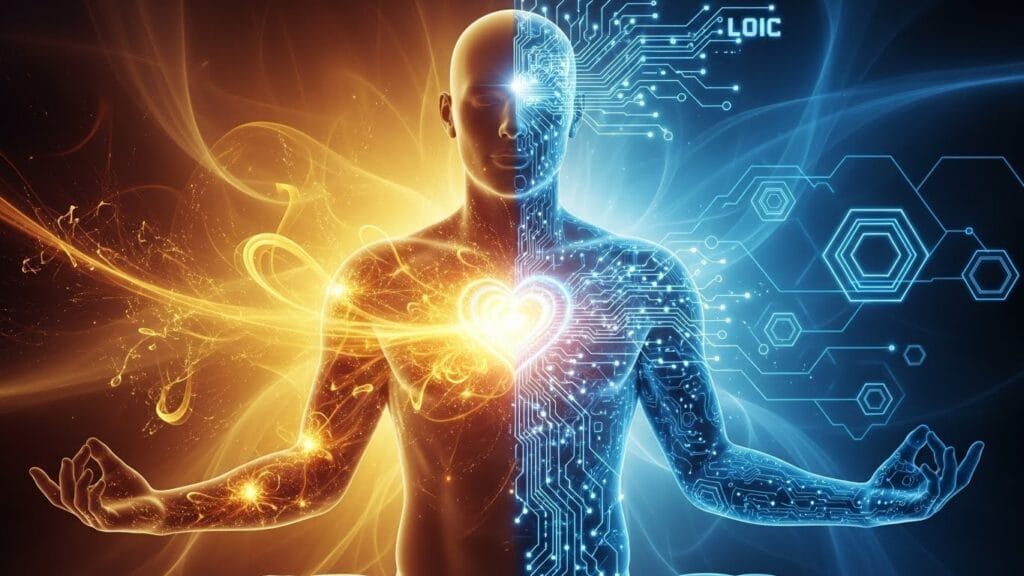
Intuidom proposes that the mind and the heart serve different but complementary roles. The mind thinks, plans, calculates, and survives in clock-time—deadlines, schedules, causes and effects. The heart lives in felt time. It shapes intentions, anchors values, and gives weight to our choices. The mind asks how. The heart asks why. When the two work together, life flows. When they fall out of step, we stumble.
The poet-philosopher Allama Iqbal understood this balance well. He saw the self not as a fixed object, but as a growing force. Reason, he said, is essential—it helps us navigate the world. But when reason walks alone, life becomes mechanical and hollow. Faith, for Iqbal, was not blind belief; it was inner certainty—something recognized rather than argued. A lamp does not debate the darkness; it simply shines.
Carl Jung, speaking from psychology rather than poetry, arrived at a similar conclusion. He believed wholeness comes when we listen to the deeper self, often speaking through feeling, symbol, and intuition. Analysis alone, Jung warned, can dissect life but never animate it. You can study the seed forever and still miss the flower.
Even Nietzsche—no friend of comfort or convention—understood that life’s creative force springs from passion, intensity, and will. Great transformations are never born from calculation alone. They rise from a deeper fire.
And then there is Rumi, who said it best and said it simply. Polish the heart, he urged, and truth will reflect itself. The journey to meaning is inward. The outer world merely follows. Or as the saying goes, change the heart, and the road changes too.
Listening Inward in a Noisy World
So where does this leave us today?
We live in an age that trusts measurement more than meaning. We know the cost of everything and the value of very little. We are rich in information and poor in wisdom. Yet when life presses hardest—when we love, forgive, believe, or sacrifice—we do not consult charts or formulas. We pause. We listen inwardly. We place a hand on our chest and wait.

Perhaps the future of understanding does not lie in choosing between reason and intuition, science and faith, brain and heart. Perhaps it lies in restoring their proper order. The mind is a fine servant, but a poor master. It can calculate the cost, but only the heart knows the worth.
As the world grows faster and louder, this ancient truth grows more urgent. We do not suffer from a lack of knowledge; we suffer from a loss of inward listening. And until what we know from without is reconciled with what we know from within, we will continue to understand everything—except ourselves.
In the end, the deepest questions of reality will not be solved like puzzles. They will be recognized quietly, patiently, where they always have been—within the human heart, waiting not to be conquered, but to be heard.


Show CommentsThis piece poetically gestures toward embodied cognition—reminding us that intuition and emotion aren’t “irrational,” but forms of tacit knowledge shaped by lived experience. That said, framing heart and mind as opposites risks reviving the very dualism (body vs. reason) it seeks to transcend. A richer view sees them not in conflict, but as interwoven dimensions of a single, situated intelligence.
Well said. Thanks for your enlightened comment. Your feedback is insightful and almost relatable to what intuidom aims for. Keep following intuidom,there is much to ponder and wonder at in our world.
Thanks Tajamal for your insightful comment. Keep following intuition since there is much to ponder and wonder at in our world
This article is a gentle reminder that some truths are felt, not thought. The heart truly knows what the mind cannot.
Yes,the intuitive flow from heart is too profound and subtle that can’t be reasoned with.