

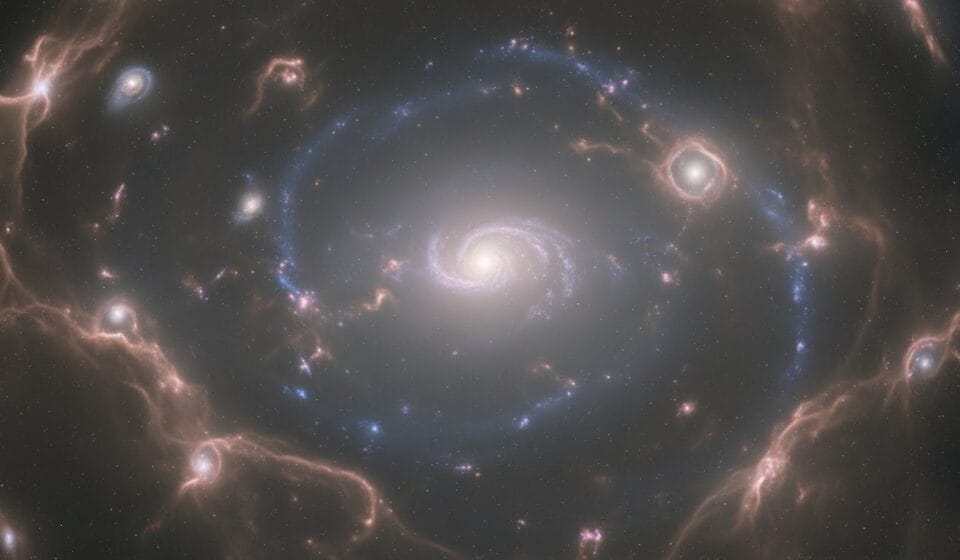
Between Time, Matter, and Consciousness: The Hidden Source of Creation

Space, Time, and the Limits of Physical Explanation
Physics begins with a deceptively simple truth: without space and time, no physical structure can exist. Space and time are not passive containers in which the universe merely unfolds; they are the very framework that makes reality possible. Without them, matter cannot form, events cannot occur, and motion—the pulse of existence—cannot arise. This insight lies at the heart of modern physics.
The Big Bang, often described as the birth of the universe, was not simply an explosion of matter and energy. It marked the emergence of time itself. As Stephen Hawking famously noted, asking what happened “before” the Big Bang is meaningless, because time itself began with that event. The universe did not emerge within time; time emerged with the universe. Hawking’s idea of imaginary time further suggests that at the deepest level of reality, familiar notions of beginnings and endings may no longer apply.
Modern physics also shows that space and time are not fixed or rigid. Spacetime bends and curves under the influence of matter and energy. Gravity, in this view, is not just a force acting inside space and time; it is the very shaping of spacetime itself. Light bends near massive objects, clocks slow down, and paths change—all because spacetime is dynamic. There is an elegance in this relationship between matter and the fabric it inhabits, a harmony that appears deeply ordered.
When Space and Time Become Emergent
At extremely small scales—around the Planck length—this smooth picture of spacetime breaks down. Scientists believe that spacetime becomes unstable and fluctuating, often described as “foamy.” Classical ideas of gravity no longer apply, and quantum effects dominate. This suggests that space and time, as we experience them, are not fundamental realities but emergent ones.
This realization opens the door to a deeper question. If time arises alongside physical structures, could there exist a more basic principle—something that does not depend on matter, space, or time? If our experience of time depends on physical processes, might there be a more fundamental source from which these processes arise? Science, for practical reasons, usually avoids such questions. Yet their persistence suggests that our current explanations may be incomplete.
Consciousness and the Question Beyond Physics
At this point, the discussion naturally turns toward consciousness. Roger Penrose, a mathematician, philosopher, and Nobel laureate in physics, has argued that human understanding cannot be fully explained as mere computation in the brain. In his book The Emperor’s New Mind, he suggested that if thought were purely mechanical, genuine understanding would be impossible. Drawing on quantum theory, Penrose pointed to phenomena such as superposition—where particles exist in multiple states at once—and argued that the instability of spacetime at quantum levels may play a role in the emergence of awareness, even in its most primitive form.
Despite extraordinary advances in science, important questions remain unanswered. How do atoms acquire such precise and stable structures? Why do subatomic particles behave with such regularity? Why are the constants of nature so finely balanced that stars, chemistry, and life can exist at all? Science explains how matter behaves with remarkable success, but the deeper why—the source of order and coherence—often remains beyond reach.
This gap points to something missing in our understanding of reality. The universe does not behave randomly or chaotically; it follows consistent patterns and laws. There seems to be an organizing principle at work—subtle, not directly observable, yet deeply influential. Its presence is suggested by the remarkable order we observe everywhere.
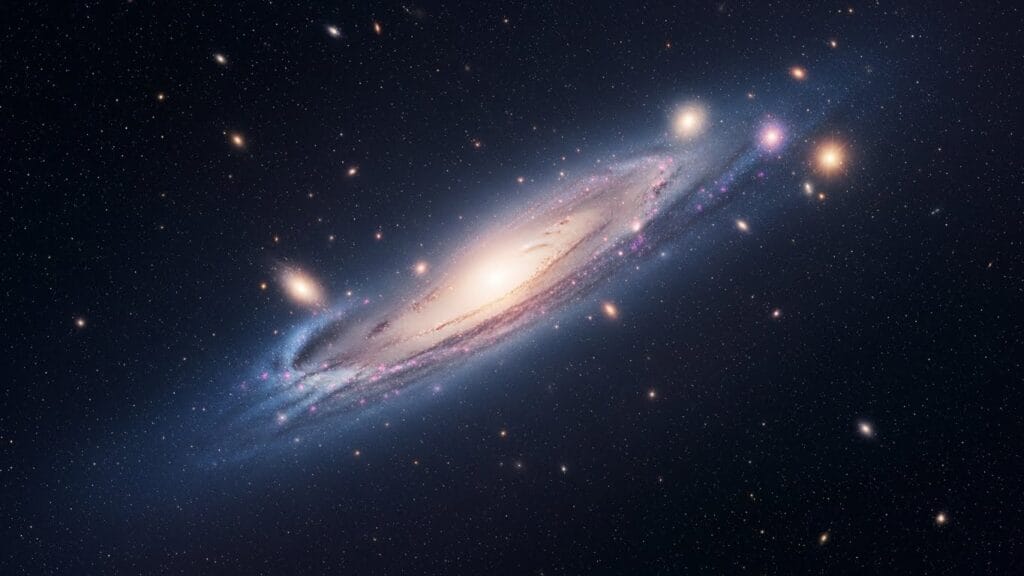
A Latent Source Beyond Space and Time
From this arises a compelling hypothesis: what if the blueprint of matter itself originates in a latent form of energy that exists beyond space and time? This would not be energy as physics currently defines it, moving through spacetime, but a deeper potential—a creative source from which physical reality unfolds. Such an energy would not age, move, or occupy space. It would simply be, serving as the foundation of all existence.
Science cannot currently confirm or deny such a proposal. Yet philosophy has long explored similar ideas. One such view is panpsychism—the idea that consciousness, or at least mind-like qualities, is a fundamental feature of reality. Under this perspective, consciousness is not an accidental product of matter; instead, matter itself may arise from a deeper, mind-like principle.
The implications of this idea are profound. If a creative principle exists beyond space and time, it naturally points toward a Supreme Source—an origin not limited by the physical dimensions of the universe. For believers, this aligns closely with the concept of God: not a being inside the universe, but the ground of the universe itself.
Creation, Consciousness, and the Religious Imagination
The Qur’an offers a striking conceptual framework for this distinction. It uses two different terms for creation: Amr and Khalq. Amr refers to a divine command—creation that does not unfold through material processes or time. Khalq, by contrast, refers to creation that occurs gradually, through stages, laws, and physical causation. In this view, Amr belongs to a non-material realm, while Khalq governs the physical universe we observe.
This distinction closely mirrors the idea of a latent creative principle beyond spacetime. Amr can be understood as directive energy—the originating command—while Khalq represents its manifestation within time and matter. Other religious traditions also speak of different modes of creation, though not always with the same clarity or philosophical precision.
The qualities attributed to this latent principle suggest that it is not merely physical but also psychological, biological, and spiritual. It appears purposeful rather than accidental. In this sense, it may be described as conscious energy—an intelligent source underlying matter, mind, and meaning. Such a principle could help explain the stability of natural laws, the emergence of life, and the reality of consciousness itself.
Here, the thought of Muhammad Iqbal becomes especially relevant. Writing in the early twentieth century, Iqbal viewed reality as dynamic, creative, and purposeful. His concept of khudi, or the self, describes human existence as active and striving rather than passive. For Iqbal, the relationship between the human self and the Infinite was participatory. Reality itself was alive with creative movement.
Western philosophy has often been cautious about granting consciousness such a foundational role. Yet in recent decades, panpsychism has returned as a serious philosophical position. Critics rightly point out its challenges, particularly the difficulty of explaining how simple forms of consciousness combine into complex minds. Thinkers such as Daniel Dennett argue that neuroscience offers no evidence that consciousness is fundamental and dismiss the so-called “hard problem” of consciousness as misleading.
Yet scientific discoveries continue to challenge strict materialism. Quantum entanglement shows that particles can remain connected across vast distances. Information theory suggests that reality may be structured by deeper informational patterns. Cognitive science increasingly recognizes that subjective experience cannot be easily reduced to brain activity alone. While inflation theory explains some aspects of the early universe, it does not reveal the ultimate nature of particles or explain consciousness.
Alongside these developments, new approaches to consciousness are emerging. Integrated Information Theory attempts to mathematically describe experience. Studies of metacognition and dual-process thinking explore how awareness operates at different levels. Though none of these approaches has solved the mystery, they collectively suggest that consciousness is more than a simple byproduct of neural machinery.
Since the Enlightenment, science has largely operated within a materialist framework. Yet philosophers such as David Chalmers, Thomas Nagel, and Giulio Tononi now argue that consciousness may be as fundamental as space and time. In this emerging view, mind and matter appear as two expressions of a deeper underlying reality.
Where Science, Philosophy, and Faith Converge
For believers across traditions—Muslims, Christians, Jews, and others—this convergence is deeply reassuring. It suggests that science and faith need not be in conflict. Rather than weakening belief in God, deeper inquiry into time, matter, and consciousness may strengthen it. The universe appears not random, but intelligible; not indifferent, but rich with meaning.
Still, empirical knowledge has limits. Measurement and calculation cannot answer our most personal questions: Who am I? Why do I love? Why do I suffer? At this point, intuition becomes essential. Intuition is not blind belief; it is an immediate form of understanding rooted in lived experience. It connects reason with meaning.
Iqbal regarded intuition as a valid mode of knowing, through which the self encounters deeper reality. Far from opposing reason, intuition completes it. The deeper science probes the universe, the more resistant reality becomes to purely mechanical explanation. Quantum uncertainty, fine-tuned laws, and conscious life all point beyond necessity alone.
Ultimately, this vision restores a sense of wonder to both science and faith. It invites us to see the universe not as a lifeless machine, but as a meaningful and purposeful reality. Reason should not bypass intuition, nor should intuition replace reason. Both must meet, guiding humanity toward a disciplined and meaningful life grounded in moral purpose.
In the end, the search for the nature of time, matter, and consciousness is a journey into the heart of existence itself. The idea that physical reality emerges from a latent, conscious source bridges science and spirituality, philosophy and faith. It reassures believers that inquiry deepens belief rather than dissolving it—and points toward what may be called the hidden heartbeat of the universe: the Supreme Creator, whose essence transcends space, time, and human understanding.
References .
Aspect, A., Dalibard, J., & Roger, G. (1982). Experimental test of Bell’s inequalities using time-varying analyzers. Physical Review Letters, 49(25), 1804–1807.
https://doi.org/10.1103/PhysRevLett.49.1804
Barrow, J. D., & Tipler, F. J. (1986). The anthropic cosmological principle. Oxford University Press.
Bell, J. S. (1964). On the Einstein Podolsky Rosen paradox. Physics Physique Fizika, 1(3), 195–200.
https://doi.org/10.1103/PhysicsPhysiqueFizika.1.195
Carroll, S. (2004). Spacetime and geometry: An introduction to general relativity. Addison-Wesley.
Chalmers, D. J. (1996). The conscious mind: In search of a fundamental theory. Oxford University Press.
Dennett, D. C. (1991). Consciousness explained. Little, Brown and Company.
Einstein, A. (1952). Relativity: The special and the general theory (Trans. R. W. Lawson). Crown Publishers. (Original work published 1916)
Goff, P. (2017). Consciousness and fundamental reality. Oxford University Press.
Hawking, S. W. (1988). A brief history of time. Bantam Books.
Hawking, S. W., & Hartle, J. B. (1983). Wave function of the universe. Physical Review D, 28(12), 2960–2975.
https://doi.org/10.1103/PhysRevD.28.2960
Iqbal, M. (2013). The reconstruction of religious thought in Islam. Stanford University Press. (Original lectures delivered 1930–1934)
Nagel, T. (2012). Mind and cosmos: Why the materialist neo-Darwinian conception of nature is almost certainly false. Oxford University Press.
Penrose, R. (1989). The emperor’s new mind. Oxford University Press.
Penrose, R. (1994). Shadows of the mind. Oxford University Press.
Rees, M. (2000). Just six numbers: The deep forces that shape the universe. Basic Books.
Rovelli, C. (2004). Quantum gravity. Cambridge University Press.
Rovelli, C. (2018). The order of time. Riverhead Books.
Smolin, L. (2006). The trouble with physics. Houghton Mifflin.
Strawson, G. (2006). Realistic monism: Why physicalism entails panpsychism. Journal of Consciousness Studies, 13(10–11), 3–31.
Tononi, G. (2008). Consciousness as integrated information: A provisional manifesto. Biological Bulletin, 215(3), 216–242.
https://doi.org/10.2307/25470707
Wheeler, J. A. (1964). Geometrodynamics and the issue of the final state. In C. DeWitt & B. DeWitt (Eds.), Relativity, groups and topology (pp. 317–520). Gordon and Breach.
Wheeler, J. A. (1990). Information, physics, quantum: The search for links. In W. Zurek (Ed.), Complexity, entropy, and the physics of information (pp. 3–28). Addison-Wesley.
The Qur’an. (n.d.). Surah Al-A‘raf (7:54); Surah Ya-Sin (36:82).

Show CommentsTime and space has been an interesting subject and controvercial but the writer sagasioually explain and tired his best to teach the readers
You are doing a great job sir
Thanks for your feedback.
Great
Thanks for your feedback.
The passage makes a compelling and accessible opening by emphasizing the foundational role of space and time in physics, rightly echoing the insights of relativity where spacetime is not merely a backdrop but an active structure shaping physical reality. Framing motion as “the pulse of existence” is philosophically evocative and effectively bridges scientific and metaphysical language.
However, the argument would benefit from greater precision. In modern theoretical physics—particularly in quantum gravity and pre–Big Bang cosmology—the status of space and time themselves is no longer settled. Some frameworks suggest that spacetime may be emergent rather than fundamental, arising from deeper, non-spatiotemporal degrees of freedom. Acknowledging this would strengthen the essay by preventing the opening claim from sounding absolute where the science is still exploratory.
Thanks for your input.I appreciate your insightul reply and hope you will stay with intuidom on its course to make meaningful contribuion in exploring what reality is. I will be in touch Haris.
This article explains a complex topic in a simple and meaningful manner. An inspiring piece that connects time, matter and consciousness beautifully.
Thanks for your comment. Keep following intuidom