

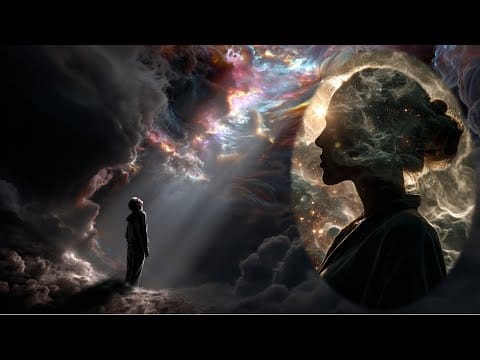
The QUANTUM MIND AND MYSTIC SOUL: A LYRICAL EXPLORATION OF CONSCIOUSNESS

AN INTUIDOM PERSPECTIVE
BY. NASIR GILL
There are questions that do not sit quietly in books.
They walk with us.
They breathe through us.
They rise in the middle of the night like an uninvited guest who whispers,
“Tell me, who are you—really?”
For centuries, humanity has tried to answer this question through reason, intuition, mathematics, metaphysics, and mystical vision. Yet the mystery only deepens. The more the telescope expands the heavens, the more the microscope reveals the inner depths, the clearer it becomes: we know very little about the knower.
Today, the inquiry stands at three luminous thresholds, each haunted by a question that refuses silence.
I. The Mind–Matter Mystery:
Where the outer world collides with the inner universe
Materialism tells us we are made of atoms, arranged by chance and refined by evolution. But when you close your eyes and taste a memory, where is that memory in the atoms? When grief breaks open the chest, where is grief in the periodic table?
Idealism counters: the mind is primary; matter is but shadow. But can a shadow give rise to the laws of physics, the orbits of planets, the birth of galaxies?
Between these stands the trembling truth:
We see the world through consciousness,
but we also see consciousness through the world.
Carl Jung glimpsed this when he spoke of the psychoid realm—where psyche and matter meet as reflections of a deeper order. Synchronicities were, to him, hints that the universe is not a cold machine but a textured fabric woven with meaning.
Across a different horizon, Roger Penrose peers into quantum processes inside the brain, wondering if consciousness is threaded into the very structure of reality—something not computed but felt by the cosmos itself.
Then Rumi arrives, dissolving the debate with a single metaphor:
“You are not a drop in the ocean.
You are the entire ocean in a drop.”
And Iqbal, echoing but refining, places agency at the center of being:
Consciousness is the growing flame,
matter the clay it shapes to express itself.
Thus the mind–matter problem is not a riddle to solve, but a mirror held between two infinities. We stand at its center—half dust, half lightning.
II. The Hard Problem:
Why does existence need a witness?
Open the brain, and you find cells.
Open the mind, and you find a universe.
This is the Hard Problem:
Why should matter arranged in a certain way produce the warmth of companionship, the sting of betrayal, the fragrance of childhood mornings?
Science maps the brain’s geography, but the traveler within—the one who sees, suffers, and dreams—remains uncharted.
Neuroscience explains the mechanism, but not the miracle.
Who is the watcher behind the eyes?
Who tastes the sweetness of sugar, hears the sorrow of a violin, feels the trembling holiness of love?
Penrose believes consciousness cannot be reduced because it participates in the architecture of reality. It is not a by-product—it is a partner.
Jung sees consciousness as the lighthouse rising out of the oceanic unconscious, illuminating fragments of a far larger psyche.
Rumi sees consciousness as a sacred window:
“The lamps are different,
but the Light is the same.”
Iqbal sees it as the Divine trust—the “amanat”—given to the human self so that the universe may awaken to its own meaning.
In every view, one truth echoes: Consciousness is not an accident.
It is an invitation.
III. The Agency Puzzle:
Who is the author of my decisions?
The neuroscientist says your brain decides first, you follow later.
The mystic says your soul knew long before your brain did.
The philosopher says free will is complicated.
The poet says free will is a flame that refuses to die.
But the ordinary human—the one with trembling hands before a life-changing choice—knows only this:
I feel I choose.
I feel I am responsible.
I feel I am the one who decides.
This feeling is not small—it is the foundation of morality, dignity, and meaning.
If consciousness is merely a narrator arriving late, then agency dissolves.
If the unconscious is the true puppeteer, then freedom collapses.
If quantum indeterminacy lies beneath, then choice may be real but probabilistic.
If the ego is evolving, as Iqbal insists, then the self gains more agency as it grows in awareness.
Rumi offers a simpler wisdom:
“When you move the way Love moves,
Your will becomes the wind’s will.”
Perhaps agency is not absolute control.
Perhaps it is alignment—
a collaboration between the conscious self, the unconscious depths,
and the whispering universe around us.
IV. Is Consciousness Fundamental, Emergent, or Interactive?
This is the crossroads where physicists, poets, and philosophers gather like travelers at dusk.
If consciousness is fundamental
—it precedes matter, shapes it, expresses itself through it.
This is the mystical vision.
The universe is a great mind dreaming in galaxies.
If consciousness is emergent.
—it arises from matter and dissolves with it.
This is the materialist view.
Though the poetry of being remains unaccounted for.
If consciousness is interactive.
—mind and matter dance in a feedback loop,
each influencing the other.
This is an integrative view, now emerging in quantum biology and philosophy.
Quantum entanglement shows particles holding hands across light-years.
Superposition shows particles waiting for conscious observation to choose a state.
The cosmos behaves less like a machine, more like a possibility that listens.
Mystics nod quietly.
For them, the world has always been alive and responsive.
Every stone has a silent story.
Every tree has a presence.
Every human carries a spark of the Infinite.
V. Do humans contain a universal consciousness whispering through the universe?
Iqbal answers boldly:
Yes.
Human consciousness is not isolated—it is connected to a deeper Reality.
The ego is not a prison; it is a portal.
Rumi answers musically:
“We are all the same light,
wrapped in different skins.”
Jung answers psychologically:
The collective unconscious holds symbols shared across all humanity.
We dream together in ways our waking minds cannot understand.
Penrose answers mathematically:
Consciousness may arise from structures embedded in the universe itself.
In all these perspectives, one idea glows:
We are local expressions of a cosmic mind.
Individual flames of a universal fire.
Notes in a symphony that began before time.
VI. Can reason grasp this, or only intuition?
Reason is a lantern—clear, disciplined, limited.
Intuition is lightning—sudden, illuminating, whole.
Reason dissects reality.
Intuition embraces it.
Iqbal warns: Reason alone leads to dryness; intuition alone leads to chaos.
The human being needs both—
the steady hand of logic
and the soaring wing of inner insight.
Science, slowly but surely, is moving toward this union.
Theories of mind now flirt with metaphysics.
Physics now whispers of consciousness.
Neuroscience now admits mystery.
Mathematics now entertains the immeasurable.
The day reason meets intuition is not far.
The disagreement is not a failure;
it is the friction that sharpens understanding.
VII. The Open Question: What shapes what—mind or matter?
Maybe mind shapes matter.
Maybe matter shapes mind.
Maybe both are waves of the same cosmic tide.
The truth is not fixed; it is unfolding.
We are living in an age when mysticism and physics
are beginning to speak the same language—
not perfectly, but with growing clarity.
Sooner or later, we may discover that consciousness is neither
a ghost inside the machine
nor a miracle outside the laws of nature.
It may be the law itself.
The pulse beneath all pulses.
The silence beneath all sound.
Conclusion: The Door That Opens Inward and Outward
We seek the nature of consciousness,
but consciousness has been seeking us far longer.
It appears in the quiet between thoughts.
It trembles in the choice that changes a life.
It glows in a mother’s gaze.
It rises in the lone wanderer staring into a star-filled sky.
The universe is not mute.
It is speaking constantly.
Our task is to listen—with reason, with intuition, with soul.
- Rumi calls it the Beloved.
- Iqbal calls it the Khudi.
- Jung calls it the Self.
- Penrose calls it a deeper order in nature.
Different names.
One mystery.
And perhaps, someday, when science and mysticism finally sit at the same table,
we will realize they were looking at the same truth from different windows.
For now, we remain children of two worlds—
matter and meaning—
walking toward the horizon where they merge into one.

Show CommentsIt’s very useful article that give us an observation abt mystic world and reality, in the age of AI, it’s essential to teach the Z generation abt Sufism and philosophy
Thanks for your comments
Notable Exploration and distinction of Scientific meaning of consciousness in terms of modern quantum physics, and Iqbal’s wide philosophy, Excellent!
Really enjoyed this! It made me think about the mind and soul in a new way. The mix of science and spirituality was very interesting, and the writing kept me engaged throughout. Great work!
Thanks for your comment, and I look forward to your suggestions.
I genuinely appreciate your flight of ideology. it offers a profound synthesis of science and spirituality, reframing the mind-matter debate as a mirror between infinities. It beautifully defines consciousness as an invitation and agency as alignment, ultimately advocating for a necessary union of reason and intuition to grasp the universal cosmic mind we embody.
Good Luck for your mission
Thanks for your comment, and I look forward to your suggestions.
I must say intuition is an unexplored region. we should voice for intuition as a legitimate source of knowledge. we are comfortable with approach of reason but must amalgamate it with intuition to tread upon untrodden paths towards ultimate truth and reality. It would be interesting journey if you go with giants of philosophy, science, sociology and literature. It will open up effective debate forum for intellectuals around.
Happy Writing!!!!
Thanks for your comments, and I look forward to your suggestions.
Wonderful piece of work.👍❤️
Thanks for your comments, and I look forward to your suggestions.