

Between Equations and Experience: A Human Search for Consciousness

When Numbers No Longer Feel Enough
There comes a quiet hour in almost every thoughtful life when numbers feel insufficient. The clock ticks, the phone glows, the world functions efficiently—and yet something essential feels missing. We know how things work, but not why they feel the way they do. We can calculate the age of the universe, yet we cannot measure the weight of sorrow, hope, or love. It is in such moments that the oldest human question returns with renewed urgency: What is reality made of—and where does consciousness belong within it?
Ancient Intuitions About Conscious Reality
This question is not new. It is as old as civilization itself. Long before laboratories and algorithms, ancient thinkers in both East and West suspected that reality was not merely material, but inwardly alive. The sages of the Upanishads spoke of Brahman—an ultimate reality known not by the senses but by awareness itself. Buddhism placed consciousness at the center of experience, insisting that the world arises dependent upon perception. Greek philosophers, from Heraclitus to Plato, sensed that the visible world might be only a surface, concealing a deeper order.
Eastern and Western Roots of Consciousness
Plato’s idealism, though framed in logic, was rooted in intuition: that truth does not reside entirely in appearances. Aristotle grounded knowledge in observation, yet never denied the mysterious nous, the intellect that apprehends meaning. Across civilizations, a quiet consensus emerged— reality without consciousness is incomplete.
From Philosophical Insight to Scientific Authority
And yet, this conviction remained a philosophical melody rather than a proven theorem. It inspired poetry and prayer, but lacked demonstration. When modern science arrived—armed with experiment, measurement, and mathematical precision—it changed the rules of knowledge itself. Physics and mathematics became the new arbiters of truth. What could not be quantified began to lose credibility.
The Demotion of Consciousness in Modern Science
The success was spectacular. Newton reduced the heavens to laws. Maxwell turned light into equations. Darwin explained life without invoking design. The universe became intelligible, predictable, and astonishingly productive. In this triumph, however, consciousness was quietly demoted—from foundation to byproduct, from mystery to mechanism.
The reigning assumption hardened: consciousness is not fundamental; it is emergent—a complex outcome of neural activity. Matter came first; mind arrived late. The universe, it was said, functioned perfectly well for billions of years before anyone was around to notice it.
What Mathematics Explains—and What It Cannot
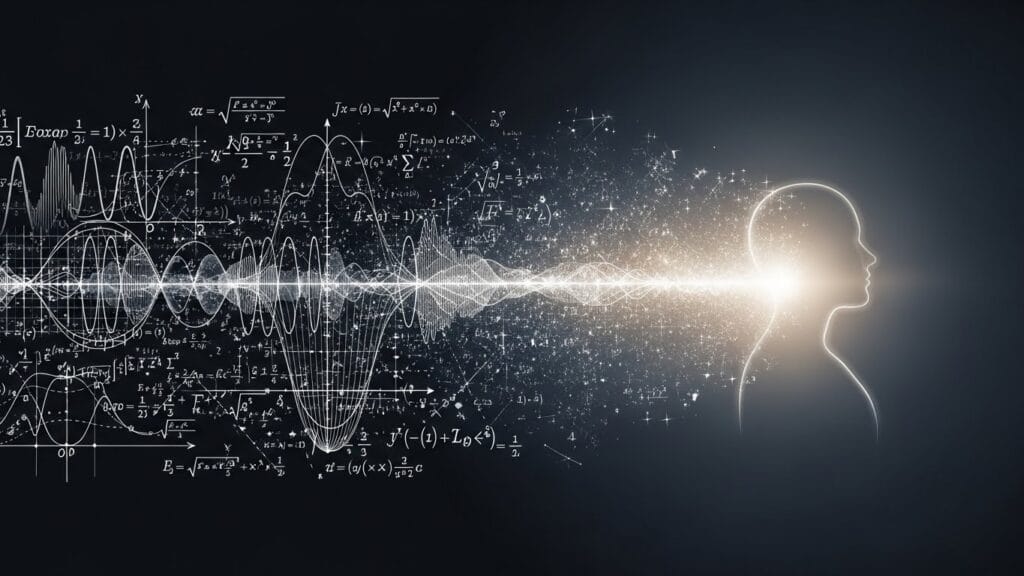
Yet here lies a subtle oversight. As Bertrand Russell—himself a mathematician of the highest order—pointed out, mathematics tells us how physical systems behave, not what they intrinsically are. Equations describe relations, not essence. They chart motion, not meaning. Physics, powerful as it is, offers a map of behavior while remaining silent about the inner nature of reality.
Bertrand Russell and Neutral Monism
Russell’s response was his theory of neutral monism—the idea that mind and matter are not two separate substances, but two expressions of a deeper, neutral reality. This was no mystical retreat; it was an honest philosophical admission. The world described by physics is structurally rich but ontologically thin. Something is missing.
Einstein and the Search for Underlying Unity
Albert Einstein sensed this too. Though often portrayed as a strict materialist, he was deeply uneasy with the idea that equations exhaust reality. His lifelong pursuit of a unified field theory was not merely technical; it was metaphysical. He sought a harmony beneath appearances—a coherence that would explain not only forces, but unity itself. He failed to complete this vision, and perhaps recognized that the mystery exceeded formalism.
The Cost of Reductionism
Thus, consciousness remained unresolved. Reductionism advanced, but meaning receded. Empiricism flourished, but moral clarity did not. Utilitarian ethics learned to calculate outcomes, yet struggled to justify dignity. The world became efficient—and existentially uncertain.
Consciousness as the Given: From Descartes to Phenomenology
René Descartes once proposed a radically different starting point: I think, therefore I am. Knowledge, he argued, begins inwardly. Consciousness is not inferred; it is given. But history reversed his trajectory. Knowledge flowed outward instead—from objects to subjects, from data to interpretation. The inner life became secondary.
Husserl, Bergson, and Lived Experience
By the late nineteenth and early twentieth centuries, philosophies like positivism, physicalism, and existentialism took hold. Meaning was declared subjective. Values were reduced to preferences. Consciousness became a shadow cast by matter. And yet—unease persisted.
The twentieth century, for all its confidence, did not silence the question of consciousness. It revived it. Philosophers like Edmund Husserl argued that science forgets its own foundation: lived experience. Henri Bergson distinguished between analytical intellect, which dissects reality, and intuition, which enters into it. Arthur Eddington reminded physicists that the only thing we know directly is experience itself; everything else is inference.
Quantum Theory and the Return of Mystery
Then came quantum theory—a scientific revolution that unsettled classical assumptions. Reality, at its deepest level, refused to behave like solid matter. Particles existed in superposition. Distant entities remained mysteriously connected through entanglement. Observation appeared to play a constitutive role. Whether or not consciousness collapses the wave function remains debated, but the philosophical shock was undeniable: the universe is stranger than materialism allows.
Even after the Big Bang theory clarified cosmic origins, deeper questions remained unanswered. What gives form to particles? Why do laws exist at all? What bridges the gap between physical description and lived experience? No equation has yet translated fear, joy, or intention into spacetime coordinates.
The Modern Human Between Science and Meaning
Here, the ordinary human being stands exposed. On one side, science offers explanation without consolation. On the other, religious experience offers meaning without consensus. Between them lies a modern soul—educated, skeptical, morally concerned, yet inwardly restless.
Is reconciliation possible?
Reason and Intuition as Partners, Not Rivals
Perhaps the error lies in treating reason and intuition as rivals rather than partners. Reason disciplines thought; intuition animates it. Reason guards against illusion; intuition protects significance. William James argued that religious experience deserves philosophical respect—not because it is infallible, but because it reveals how humans actually live and choose. Kant himself admitted that reason has limits—and that meaning begins where calculation ends.
Consciousness as the Interior of Reality
Consciousness may not be reducible to matter, nor separable from it. It may be the interior dimension of reality—what physics observes from without, experience reveals from within. Science maps the coastline; intuition sails the sea.
Such a view does not abandon empiricism; it humbles it. It does not sanctify subjectivity; it situates it. It restores consciousness not as an enemy of science, but as its silent partner.

Iqbal and the Completion of Knowledge
Here, a gentle coherence emerges. Knowledge from without and knowledge from within need not cancel each other. They may converge. Biology may explain the brain, psychology the mind, physics the structure of the cosmos—but consciousness gives them relevance. Without it, equations float meaninglessly through a universe no one inhabits.
In this light, the joy of understanding becomes sacred. Spinoza called it the highest joy—not pleasure, not power, but clarity. How, then, can a civilization flourish if consciousness is excluded from its deepest theories? How can people feel at home in a world that treats awareness as an accident?
It is here that Muhammad Iqbal quietly enters—not as a preacher, but as a philosopher-poet. Iqbal did not reject science; he rejected reduction. For him, consciousness—the khudi, the self—was creative, dynamic, and real. Reality, he believed, unfolds through lived experience, not abstract finality. Knowledge from without must be completed by knowledge from within, or it remains unfinished.
To Understand More Deeply Is to Live More Humanly
Iqbal offers no closed system, no final proof. He offers something rarer: intellectual courage joined with spiritual humility. In a world pressed by utility and haunted by doubt, this balance comforts without deceiving. It reminds us that understanding itself is a form of meaning—and that consciousness, far from being an embarrassment to science, may be its most intimate mystery.
And perhaps that is enough. For in an uncertain world, to understand a little more deeply is already to live a little more humanly.

Show Commentsthere is a beautiful synchronization of sub consciousness with physics and metaphysics. A daring quest to explore the hidden truth of our state of being . I must acknowledge “Science maps the coastline; intuition sails the sea.” hopefully we will have a vessel one day to navigate through the sea of doubt.
Good Luck!!!
Thanks for your comment and I look forward for your suggestions to improve the content.
Ground breaking
Thanks for your comment.
Ground breaking
Thanks.
there is a beautiful synchronization of sub consciousness with physics and metaphysics. .
Best of luck
Thanks for your comment.
There is a graceful harmony between the subconscious and the realms of physics and metaphysics—a courageous quest to uncover the hidden truths of our existence. As rightly said, “Science maps the coastline; intuition sails the sea.” Hopefully, one day we will possess a vessel strong enough to navigate the vast sea of doubt and discovery.
Thanks for your comment and i look forward for your suggestions to improve the content.
Clear, concise, and very persuasive. Keep up the great work!”
Thanks for your comment.