

Reality, Consciousness, and Love: An Intuidom Synthesis

Reality at the Edge of the Seen and the Unseen
What is reality, and where do its deepest roots extend—into matter, the self, or the silent depths of the soul? Is the visible world self-sufficient, or merely a veil drawn over an invisible order that gives it meaning and coherence? Since the Renaissance enthroned doubt-driven reason as the sovereign of knowledge, this question has haunted philosophy: how the seen is bound to the unseen, and by what inner faculty this ancient mystery might finally be approached.
Science Mastered the World but Missed its Meaning
Modern science stands among the great achievements of the human intellect. From Newton’s laws to Einstein’s spacetime, from quantum fields to evolutionary biology, it has rendered the universe intelligible with remarkable precision. Yet this triumph is methodological rather than metaphysical. Science excels at explaining how phenomena occur, not what it ultimately means for anything to exist at all. It maps relations, measures structures, and predicts functions, but it remains silent about inner presence, meaning, and awareness—the very qualities that make reality experienced rather than merely inferred.
Reality Without The Witness
This silence is not accidental. Modern science advances by privileging third-person objectivity and suspending first-person experience. Consciousness—our capacity to feel, perceive, suffer, love, and reflect—is treated as secondary, derivative, or even illusory. Reductionism and physicalism follow naturally: if only what is measurable is real, then mind must be reducible to matter. Yet this posture conceals a quiet contradiction. Every measurement presupposes a measuring subject; every theory presupposes awareness. To deny consciousness epistemic significance is to erode the very ground upon which knowledge stands.
When Objectivity Forgets the Knower
In its quest for objectivity, science has set aside the insights of experiential realism, where Descartes affirmed “I think, therefore I am,” Bergson spoke of durée as the living flow of time, and Iqbal envisioned the Khudi as a self realized from within. By favoring only what can be measured, science risks denying the inner source from which all knowledge first arises. Is this not a turning away from truth itself? The cost is subtle yet grave: a precise understanding of the world that loses sight of the conscious self through which the world is known at all.
The Untold Story Of Consciousness
Despite its acknowledged subjective intricacies, science continues to treat consciousness as an emergent phenomenon—a byproduct of neurochemical and neuro-electrical processes in the brain. Yet this claim itself exceeds what is empirically observed. Consciousness is not seen to emerge; it is assumed to do so. In this way, science risks loosening its own empirical discipline, substituting a metaphysical assumption for demonstrable evidence, while presenting it under the banner of objectivity.
What Science Leaves Unsaid
Ordinary experience exposes this limitation with striking clarity. Pain can be correlated with neural activity, but its felt intensity cannot be located in any scan. Color can be described by wavelengths, yet the redness of red never appears in equations. Love may coincide with hormones and neural circuits, but the meaning of loving—of being drawn beyond oneself—eludes chemical description. Time can be measured by clocks, but the lived flow of time, stretching in boredom and collapsing in joy, exists only within consciousness. These are not marginal phenomena; they constitute the texture of reality as lived.
Consciousness: The Soul’s Independent Witness.
As lived experience, consciousness appears to belong to the soul and to stand in a certain independence from the body. Yet no empirical inquiry has succeeded in isolating it as a measurable entity. Consciousness remains an inward certainty rather than an outwardly verifiable fact—a presence immediately known to itself, yet elusive to every instrument of observation.
The Brain Is Not A Measure Of Consciousness
Functional accounts of the brain, however refined, explain behavior, information processing, and causal roles. They do not explain experience itself. They tell us what the brain does, not what it is like to be the subject of those processes. The central mystery remains untouched: what is it like to be me? How does the self appear as an “I,” the undeniable presence at the center of experience? By what means do I possess immediate access to an inner sentience distinct from perceptions, thoughts, and behavioral dispositions?
The Hard Problem of Consciousness
This irreducible first-person dimension—variously called qualia, awareness, or consciousness—resists capture by objective data alone. Here lies the explanatory gap that marks the limit of reductive accounts. It was for this reason that David Chalmers spoke of the “hard problem” of consciousness: not the problem of explaining cognitive functions or behavior, but the deeper question of why physical processes give rise to lived experience—why there is something it is like to be a conscious organism.
Psychology, Biology and the Hard Problem of Consciousness
Can biology and psychology uncover a hidden clue to reality by confronting the hard problem of consciousness, or do they merely circle its edges? From Chalmers’ insistence that subjective experience resists reduction, to Crick’s bold attempt to locate mind within neural mechanisms, and Damasio’s account of consciousness as embodied feeling, the sciences have illuminated much—yet not the inner light itself. Even the heart’s measurable electromagnetic field, extending beyond the body, invites speculation about subtle bridges between the seen and the unseen, though its deeper significance remains unresolved. For now, these disciplines advance with rigor and humility, aware that empirical progress may narrow the gap between subject and object. But, may never fully dissolve the veil that separates experience from explanation.
Illusionism and the Unresolved Depth of Consciousness
Daniel Dennett’s philosophy of mind denies that consciousness possesses any special inner essence beyond physical and functional processes, treating qualia—the felt redness of red or the pain of pain—as cognitive illusions generated by the brain. By rejecting the need for non-physical explanation, Dennett aims to dissolve the hard problem of consciousness rather than answer it. Yet this move rests not on decisive empirical proof but on a prior naturalistic commitment that re-describes experience instead of explaining its felt reality. Illusionism thus does not resolve the mystery of consciousness; it reframes it, offering a philosophically coherent stance shaped by science rather than a conclusion that compels assent.
The Return of Pan-psychism
The hard problem has unsettled the confidence of reductive materialism and reopened a question long thought closed. In response, pan-psychism has re-emerged—not as a retreat into pre-scientific myth, but as a serious metaphysical proposal. It suggests that consciousness is not a late anomaly in an otherwise insentient universe, but a fundamental and ubiquitous feature of reality, present from the beginning and articulated progressively through complexity.
Ancient Wisdom, Modern Pan-psychism
This intuition is ancient. Metaphysical philosophy names it panpsychism; the mystical tradition speaks of universal consciousness or wahdat al-shuʿūr—the unity of awareness underlying all forms. The insight fell into eclipse when Galileo expelled consciousness from mathematical description, confining science to quantities alone. Yet with the ferment of quantum physics, the question of mind has returned to ontology. Contemporary thinkers such as David Chalmers, Galen Strawson, Philip Goff, and Hedda Hassel have revived panpsychism with renewed rigor, arguing that consciousness is not an accidental byproduct of matter but one of its basic modes of being.
The Intuidom Hypothesis
Intuidom interprets this impasse as a sign that reality has not been characterized organically as a whole by scientific evaluations, so far. Consciousness is not a late arrival in a dead universe; it is a fundamental feature of existence. If consciousness were wholly absent from reality, its sudden appearance in human brains would be metaphysically inexplicable. A more coherent view is that consciousness exists in latent or rudimentary form at the most basic level of being and becomes explicit through complex organization. It is Intuidom’s philosophical intuition elevated to a Principle that underlies the fabric of reality.
The Inner Song Of Self
To say that the universe is conscious does not mean it thinks or feels as humans do. It means that being itself is not devoid of interiority. As Bertrand Russell and Arthur Eddington observed, physics describes only the external relations of matter, not its intrinsic nature. Consciousness may offer our only direct glimpse into what that intrinsic nature is like from within. Roger Penrose further strengthened this view by arguing that consciousness is not computational and therefore cannot be captured by mathematical formalism alone.
Where Consciousness Meets Love
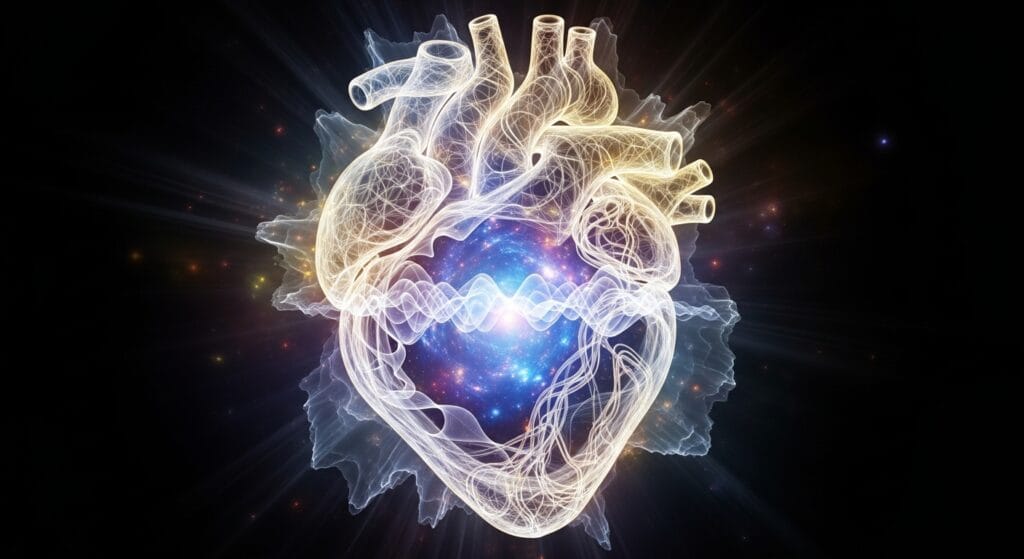
Intuidom advances a decisive step further: consciousness does not exhaust reality’s depth; it is inseparable from love. Love, in this sense, is not mere emotion but the principle of relation, unity, and meaning. Wherever there is awareness, there is valuation—something matters. This valuing is the seed of love.
The Grammar Of Love And Meaning
Human experience again provides the clue. We do not merely perceive the world; we care about it. Meaning arises through concern, attachment, and relation. Even knowledge is guided by interest and wonder. Love intensifies consciousness by dissolving isolation and revealing unity. In loving, the boundary between self and other becomes permeable, and reality appears as a coherent whole rather than a collection of fragments.
A Universe That Knows And Cares
If reality were wholly indifferent, such relational depth would be unintelligible. Intuidom therefore holds that
consciousness and love are fundamental components of reality.
Consciousness is the inner light of being; love is its connective force. They are not separate substances but two aspects of a single reality.
Where Existence Becomes Experience
In this view, being and experiencing are not two distinct orders—one objective and one subjective—but a unified process. The universe does not merely exist mechanically; it expresses itself meaningfully through conscious participation. Human awareness is not an anomaly in a dead cosmos but a local intensification of a universal principle.
The Common Heart Of Faith
The great theistic traditions converge on this insight. Reality is not a blind mechanism but an expression of an all-knowing and all-loving Divine Presence. In Islam, Divine consciousness is inseparable from Divine mercy, affirmed through the names Ar-Rahmān and Ar-Rahīm. “My mercy encompasses all things” (Qur’an 7:156) is not moral sentiment but ontological declaration. Existence itself unfolds within mercy.
Knowing as Sacred Participation
The Qur’anic teaching “He taught Adam the names of all things” (2:31) signifies that awareness and meaning are woven into creation. To know is to participate in Divine consciousness. In the Christian tradition, “God is love” (1 John 4:8) is not metaphor but metaphysics. Likewise, “In Him we live and move and have our being” (Acts 17:28) affirms that existence itself abides within Divine awareness.
Mysticism: Where Love And Consciousness Merge
Mystical traditions speak with a shared intuition, though in many tongues: consciousness and love are not accidental ornaments of existence; they are the very warp and weft of reality.
Jalaluddin Rumi gives this truth its timeless voice; “Love is the bridge between you and everything.” Love, for Rumi, is not emotion alone but a cosmic force through which the soul recognizes its kinship with the whole.
This insight is not confined to Islam. Christian mystics like Meister Eckhart speak of God as the ground of being, discovered not through external proofs but through the inward awakening of the soul in love. St. Augustine’s confession—“You were within me, but I was outside”—resonates with the same inward turn toward conscious presence. In Hindu thought, the Upanishads declare Tat Tvam Asi—“That Thou Art”—affirming that the deepest consciousness of the self is identical with the ultimate reality, Brahman. Buddhism grounds liberation in prajñā (awareness) and karuṇā (compassion), revealing that insight and love arise together as expressions of awakened mind.
Across these traditions, a single truth glimmers that reality is not merely to be observed, but to be lived from within.
Iqbal: Love as the Intensifier of Consciousness
Muhammad Iqbal articulated this vision through the dynamism of khudi. Reality, for Iqbal, is a conscious, creative movement striving toward self-realization. “The ultimate aim of the ego is not to see something, but to be something.” Love (ishq) intensifies consciousness and propels existence toward unity and freedom. A universe capable of producing creative, loving selves cannot itself be devoid of inner life.
Interplay of Love, Consciousness and Self
Iqbal stresses that Consciousness is born where awareness becomes earned through struggle, not merely learned through repetition. Ego is not an enemy when it strives, but a prison when it hardens into hatred, jealousy, greed, and blind prejudice. These traits scatter the self and weaken its flame. The true Khudi grows by discipline, love, and creative action. Only the purified ego rises—from knowing, to being, to becoming at the interplay of love, consciousness and self.
Jung and the Interior of the Cosmos
Carl Jung rejected the notion that consciousness is accidental, observing that the psyche carries an ancient inheritance. Archetypes reveal an interior, symbolic dimension of reality expressing itself through the human mind. Love functions as an integrative force, binding opposites and enabling wholeness, both individually and cosmically.
Bergson and Creative Duration
Henri Bergson offered metaphysical rhythm to this vision. Reality, he argued, is not mechanism but lived duration—creative becoming. Consciousness is the flow of this creativity. Love may be understood as the vital impulse that drives novelty, freedom, and emergence.
Intuidom’s Ontological Synthesis
Taken together, these perspectives converge on Intuidom’s central claim: consciousness and love are not products of reality; they are its foundations. The universe is conscious not as a mind, but as a unified field of interiority capable of relation and meaning. Love binds this field into coherence; consciousness illuminates it from within. Without consciousness, love would be directionless; without love, consciousness would be sterile. They are two inseparable dimensions of a single, living reality.
The Eternal Now: Where Becoming Touches Being
The eternal Now is not a distant metaphysical abstraction, nor a timeless realm postponed beyond history and experience. It is immanent in every moment of lived awareness, quietly breathing within experience as it unfolds. Each instant of consciousness carries a depth that exceeds chronological time—a fullness in which memory and anticipation are gathered without being erased. Becoming, therefore, is not a blind procession of events, but a meaningful movement in which existence continuously opens itself to self-disclosure. Time is not merely something that happens to consciousness; it is the medium through which consciousness deepens.
Love as the Bridge Between Time and Eternity
Love is the inward force through which temporality touches eternity. In loving, consciousness does not merely endure time; it is gathered into the depth of presence. The finite moment becomes translucent to the infinite, and duration is no longer experienced as loss alone, but as participation. Love intensifies awareness by dissolving isolation, allowing the self to transcend its enclosure without abandoning its identity. Through love, becoming ceases to be mere change and becomes continuity of meaning—an ascent rather than a dispersal.
Divine Immanence and the Nearness of God
From this perspective, God is not encountered at the margins of existence, nor deferred to a transcendent elsewhere. God is present now—in the pulse of awareness, in the trembling intimacy of relation, in the silent recognition through which the self encounters the other. Religious wisdom has long articulated this immediacy with luminous clarity: “God is closer than the jugular vein.” Nearer than thought, nearer than breath, nearer even than the self that seeks Him, the Divine abides as the innermost depth of consciousness and the sustaining ground of all relation.
One Reality, Many Names
Thus God, love, and consciousness are not three separate themes but three names for a single reality apprehended from different angles. Consciousness is the field in which love awakens; love is the movement through which consciousness transcends itself; and God is the ever-present depth that makes both awakening and transcendence possible. To live fully in love is to dwell in the eternal Now, and to dwell in the eternal Now is already to stand in the presence of God. Here metaphysics does not fall silent in defeat, but in reverence—recognizing that the deepest truths are not merely explained, but lived.
References
Bergson, H. (1911). Creative evolution (A. Mitchell, Trans.). Henry Holt and Company. (Original work published 1907)
Chalmers, D. J. (1996). The conscious mind: In search of a fundamental theory. Oxford University Press.
Crick, F. (1994). The astonishing hypothesis: The scientific search for the soul. Scribner.
Damasio, A. (1999). The feeling of what happens: Body and emotion in the making of consciousness. Harcourt Brace.
Eddington, A. S. (1928). The nature of the physical world. Cambridge University Press.
Goff, P. (2017). Consciousness and fundamental reality. Oxford University Press.
Iqbal, M. (1934). The reconstruction of religious thought in Islam. Oxford University Press.
Jung, C. G. (1964). Man and his symbols. Doubleday.
Penrose, R. (1994). Shadows of the mind: A search for the missing science of consciousness. Oxford University Press.
Russell, B. (1927).The analysis of matter. Kegan Paul.
Strawson, G. (2006). Realistic monism: Why physicalism entails panpsychism. Journal of Consciousness Studies.
Hard problem of consciousness:
(Chalmers, 1996)
Dennett’s illusionism and rejection of qualia:
(Dennett, 1991; Dennett, 2017)
Intrinsic nature of matter and interiority:
(Russell, 1927; Eddington, 1928)
Panpsychism revival:
(Strawson, 2006; Goff, 2017)

Show CommentsHere’s a comprehensive commentary on the philosophy suggested by “Reality, Consciousness, and Love: An Intuidom Synthesis” — understood in context from Intuidom (the site intuidom.org and related editorial/critical material) and broader intellectual traditions connected to this theme:
Thanks for your comment, keep following intuidom.
The essay offers a compelling and insightful exploration of reality, consciousness, and love. Its ideas are presented with clarity while preserving philosophical depth.
The integration of emotional and intellectual perspectives feels natural and engaging. It invites the reader to reflect on personal experience as part of a larger whole.
The ideas are profound yet accessible, encouraging genuine reflection rather than abstract theorizing. It leaves the reader with a lasting sense of insight, wonder, and emotional resonance.
Thanks for appreciating intuidom essay. You know what, philosophers believe that consciousness is the only clue that God gave us to be beholden of the thought of His majestic presence in the world. Science in it’s chauvinistic approach of reductionistic determinism is just shying away from the prospect, but days are not far away thanks to quantum physics, that science will subscribe to the ontological fundamentality of consciousness. You will get more of consciousness because there is an hectic debate going on all over the world.
Really an inspiring and insightful thought about consciousness. It reflects on how reality is fundamentally linked to consciousness . Well done intuidom. Keep it up.
Thanks for your encouraging words for intuidom. You will get more about consciousness.
The basic object of every human being is to know thyself through any medium . It is either love or
Knowledge
Oh yes, knowing thyself is knowing reality.Truth lies in experiential realism. But science only points to objective physicalism. Which is a fragment not a whole. Thanks for your comment.
This article gives a thoughtful view on how reality, consciousness and love are connected. It encourages us to reflect on ourselves and understand life more deeply.
Thanks for your appreciation. Keep following intuidom
Oh, you have wonderfully developed your synthesis well. Underneath consciousness, there lies the deep link of love that connects us all. Write more about love, the universal constant of all beings.
Thanks for your approval. Yes, I will write more about love because the more you learn about love, the less you know. Keep following Intuidom.