

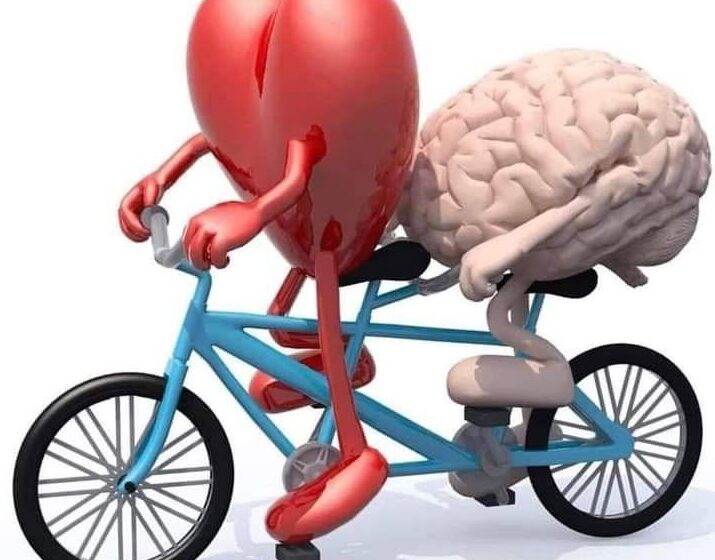
The Heart, Faith, Intuition, and the Mystery of Self

By Nasir Gill
What does it feel like to be “I”—to exist as a self, aware of oneself from within? How do I feel love, and from where does hatred arise? How does faith take hold inside me, and from what inner depth does it draw its authority? What is bravery, and why do human beings willingly surrender their lives for honor, ideals, or love? Why do certain colors, sounds, or faces move me without reason?

These are not peripheral questions of psychology or taste. They arise from the subjective core of human existence—the irreducible first-person domain in which meaning, value, emotion, intention, and identity are formed. This inner world, accessible only to the experiencer, defines what it feels like to be human. Though philosophy, religion, and neuroscience have grappled with this domain for centuries, it remains one of the most profound unresolved problems of modern thought: what contemporary philosophy famously terms the “hard problem” of consciousness.
The subjective self encompasses perception, emotion, belief, imagination, creativity, moral conviction, intention, and the sense of selfhood itself. Yet it stands in sharp contrast to objective reality, which can be observed, measured, verified, and shared. Objectivity is public and repeatable; subjectivity is private, lived, and contingent. Science, by its very design, excels at the former. And it is precisely here—at the boundary between inner experience and external measurement—that its explanatory reach begins to fracture.
Modern neuroscience seeks to explain subjective experience by identifying neural correlates: patterns of brain activity, chemical signaling, and structural organization. These approaches have yielded extraordinary insights into cognition and behavior. Yet they stop short of answering the central question: how does physical matter give rise to qualitative experience itself? No amount of third-person data explains why red feels red, why grief aches, or why love overwhelms. The jump from neural activity to lived experience remains unexplained. This gap is not accidental; it is structural.
Despite this limitation, contemporary science largely maintains that all subjective experience originates exclusively in the brain. Yet this claim collides with a profound, cross-cultural anomaly: the persistent and universal association of love, intuition, faith, courage, moral insight, and meaning with the human heart.
If the brain alone generates love and hatred, why have human beings across civilizations spoken of a pure heart, a hardened heart, a broken heart, or a burning heart—and never of a broken brain? Why do languages instinctively locate sincerity, compassion, and courage in the heart? Why does love feel rhythmic, resonant, almost musical—synchronized with the heartbeat itself? Why has the heart, and not the brain, become the universal symbol of devotion and fidelity?
These questions are not sentimental indulgences. They are philosophically serious, scientifically relevant, and culturally unavoidable.
The Heart in History and Sacred Knowledge
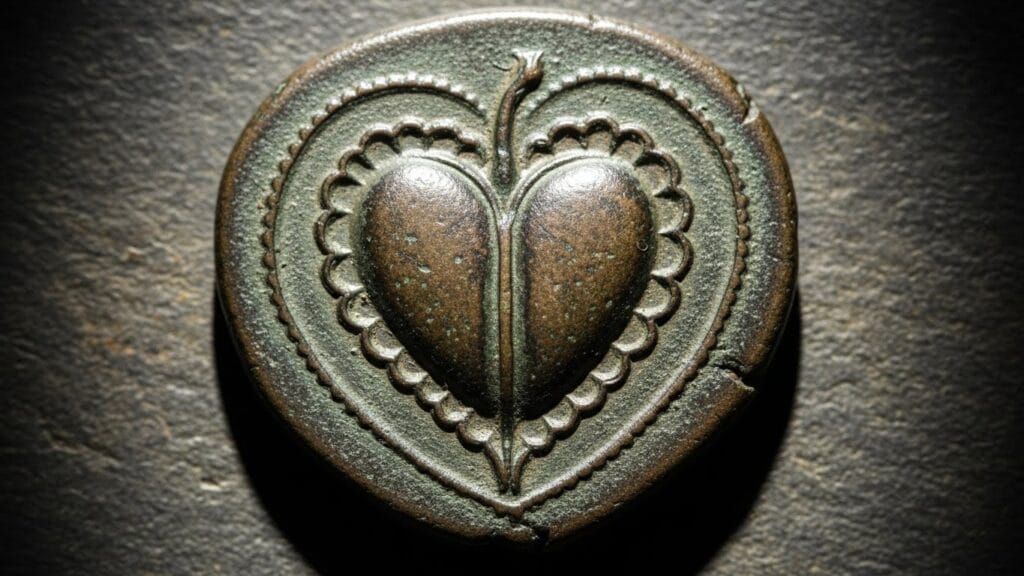
Long before modern science, ancient philosophers identified the heart as central to human life. Plato located powerful emotions—love, anger, fear—in the chest. Aristotle went further, granting the heart supremacy over cognition itself, viewing the brain as secondary. Roman culture embraced the heart as the seat of love, passion, and courage. They credited the goddess of love for setting hearts on fire. Archaeological evidence from the ancient city of Rome, Cyrene (510–490 BC) reveals heart imagery on a coin. The transformation of the heart from a symbol of love into a verb is inseparable from subjective nature of human experience and is rooted in remarkable history.
Religious traditions deepen this association with an amazing unanimity.
In the Qur’an, the heart (qalb) is not merely emotional; it is epistemic. It is the organ of understanding, faith, moral discernment, and spiritual insight:
“Have they not traveled through the land, so that they may have hearts with which to understand and ears with which to hear? Indeed, it is not the eyes that grow blind, but the hearts within the breasts.”
(Qur’an 22:46)
Here, understanding (fiqh) is explicitly attributed to the heart. Revelation itself is said to descend upon the heart of the Prophet:
“The Trustworthy Spirit has brought it down upon your heart, that you may be among the warners.”
(Qur’an 26:193–194)
Salvation is framed not in terms of intellect or accumulation, but inner soundness:
“The Day when neither wealth nor children will benefit, except one who comes to Allah with a sound heart.”
(Qur’an 26:88–89)
The Bible echoes this vision. Proverbs 4:23 declares:
“Guard your heart with all diligence, for from it flow the springs of life.”
And Samuel 16:7 reminds:
“Man looks at the outward appearance, but the Lord looks at the heart.”
In the Bhagavad Gita, the heart (hridaya) is the dwelling of Atman and Paramatma, the meeting point of the individual soul and the absolute. Heart is considered the metaphorical location where the individual soul and the highest self reside, and it is the core of the intellect (buddhi) where understanding occurs.
In Buddhism, particularly Mahayana thought, the Heart Sutra stands as the distilled wisdom of enlightenment itself. Across traditions, the heart emerges as the center of being, not merely emotion.
Science and the Return of the Heart
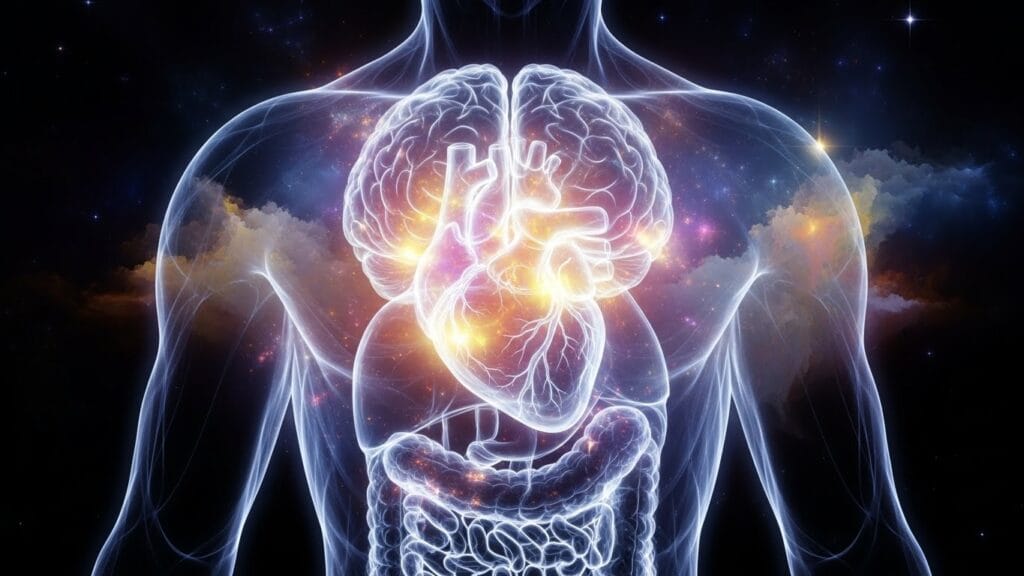
Strikingly, modern science has begun to circle back toward this ancient intuition. Neuro-cardiology reveals that the heart possesses its own intrinsic nervous system—approximately 40,000 neurons—capable of independent learning, memory, and information processing. This “little brain” communicates bi-directionally with the cranial brain.
Signals originating from the heart significantly influence emotional regulation, decision-making, attention, and cognitive clarity. Studies have also provided a scientific base for more research that “how” and “why” the heart affects creativity and emotional balance.
The heart’s electromagnetic field is far more stronger than the brain’s and extends several feet beyond the body. Research has shown that the heart releases oxytocin, the hormone of bonding and trust, and participates actively in processing independent information.
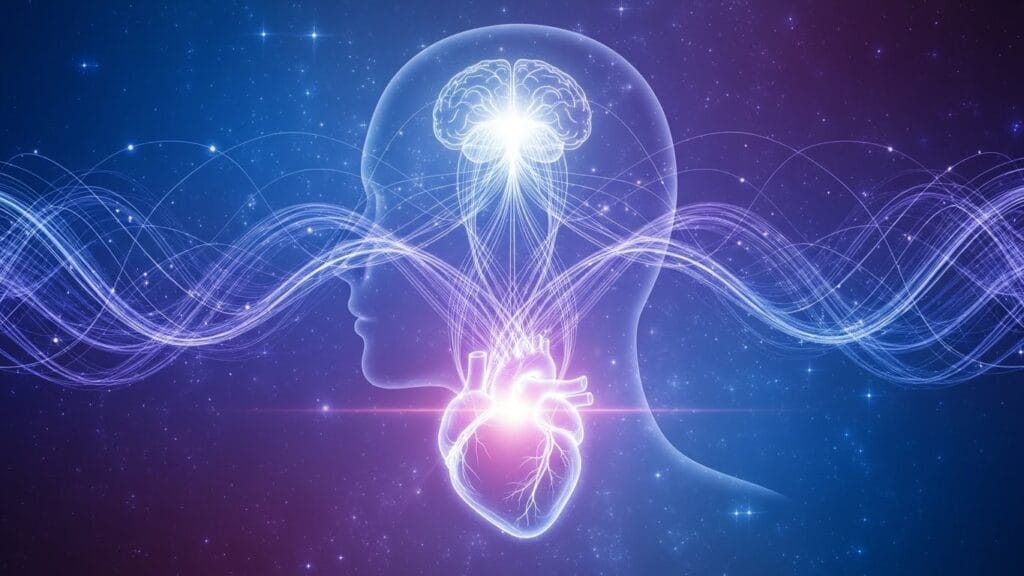
In context of relationship between the heart and intuition research shows that the heart is involved in the processing and decoding of intuitive information. Previous data showed that the heart field was directly involved in intuitive perception through its coupling to an energetic information field outside the bounds of space and time. Using a rigorous experimental design there was evidence that both the heart and brain receive and respond to information about future events before the event actually happens.
It was also found that the heart seemed to have it’s own peculiar logic that frequently diverged from the direction of the autonomous nervous system. But, does the mind obey signals sent by the heart? Studies reveal astonishing results—– showing that neural pathways and mechanisms whereby input from heart to brain could inhibit or facilitate the brain’s electronic activity.
Even more provocatively, experimental studies suggest that the heart plays a role in intuitive perception, responding to meaningful stimuli before conscious cortical awareness. In some cases, physiological signals from the heart appear to precede brain responses, challenging the assumption that consciousness is generated solely in the cortex.
These findings suggest that consciousness may emerge not from the brain alone, but from an integrated heart–brain–body system.
The Intuidom Hypothesis
Traditionally, philosophy privileged the mind as the seat of reason and consciousness, from Plato’s “logos” to Descartes “cogito”. Yet this rational dominance has always faced a quiet rival: the heart
Against this backdrop, Intuidom proposes a reorientation of inquiry into the subjective self:
The ego speaks, reacts, calculates, and adapts within serial time through the mind (aql), while the heart listens, aligns with pure duration, and shapes intentions and core emotions—love, hatred, jealousy, courage—thereby forming the finite personality.

The ego operates within linear, measurable time, adjusting to the external world of cause and effect. The heart, by contrast, aligns with pure duration—a lived, qualitative time beyond clocks and sequences. It is here that intentions are formed, values crystallized, and the deepest emotions take shape.
This framework finds resonance across philosophy, psychology, and mysticism.
Iqbal: Khudi, Duration, and the Heart
Allama Iqbal viewed the self (khudi) as a dynamic, striving reality—not a static substance. He distinguished between the efficient self, operating in serial time to master the external world, and the appreciative self, rooted in intuition and lived duration.
Reason (aql), for Iqbal, is indispensable. It is the “Khizr” guiding humanity through the terrain of causality. Yet reason alone is insufficient. When the ego becomes trapped in serial time, life fragments into mechanical routine—a “ring of smoke.” The heart anchors the self in living time, enabling creative evolution and movement toward the Infinite.
For Iqbal, faith is not blind belief but intuitive certainty, emerging from the heart’s alignment with deeper reality.
Carl Jung: Heart and Individuation
Carl Jung’s depth psychology maps closely onto Intuidom. Jung distinguished the conscious ego from the deeper Self, accessed through symbols, dreams, and intuition. Individuation—the process of becoming whole—requires integrating unconscious elements with conscious identity.
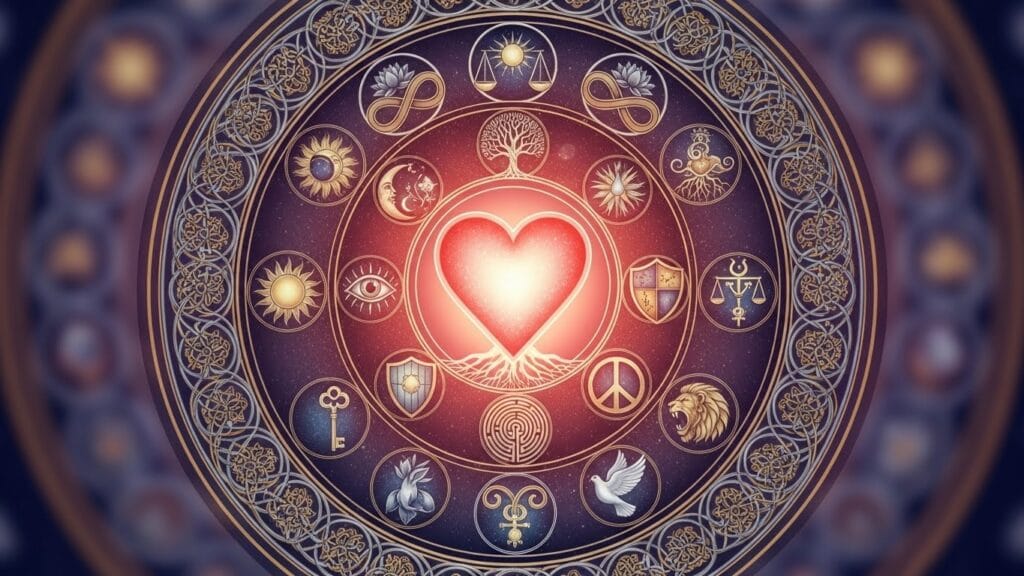
Jung frequently described the heart as a transformative center, the locus of the transcendent function, where opposing forces—reason and emotion, conscious and unconscious—are held in creative tension. He spoke of an “inner controller” residing in the heart, guiding the ego toward wholeness.
In Jungian terms, the heart functions as the threshold of individuation, where meaning emerges not from analysis alone but from lived integration.
Nietzsche: Passion, Will, and Creation
Nietzsche rejected detached rationalism and moral complacency. For him, life is driven by will, intensity, and passion. Love, hatred, jealousy, ambition, and courage are not weaknesses but the raw energies from which greatness is forged.
The Übermensch does not emerge from calculation but from the capacity to affirm life through powerful emotion. In this sense, Nietzsche aligns with Intuidom’s recognition of emotion as ontological force, though he would resist the heart’s receptive posture, emphasizing instead its assertive, world-shaping power.
Bergson and Pure Duration
Henri Bergson’s philosophy of durée underpins Intuidom’s temporal distinction. Pure duration is not measurable time but lived continuity—fluid, creative, qualitative. Intellect spatializes time, turning it into units; intuition experiences it directly.
The heart, aligned with duration, participates in life’s creative flow. It does not calculate; it knows.
Rumi and the Mystical Heart
No thinker articulates the primacy of the heart more eloquently than Jalaluddin Rumi:
“The light of the eye is the light of the heart,
and the light of the heart is the light of God—
separate from the light of intellect and sense.”
Elsewhere he writes:
“Why are you busy with the form?
Leave the shell, take the pearl—
the heart is the ocean where the pearl is found.”
For Rumi, the heart is not a metaphor but an epistemology. The journey to the Beloved unfolds inwardly. The outer world reflects the heart’s state. Yet this journey requires purification—the polishing of the heart from ego (nafs) and attachment.
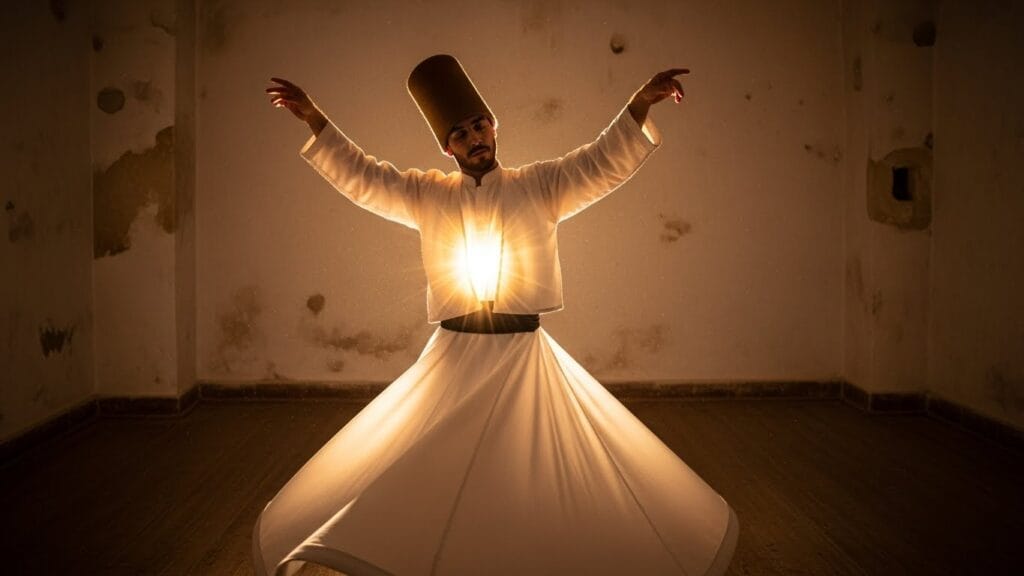
Al-Ghazali described the heart as the abode of God, requiring cleansing so that divine knowledge may be reflected like light on a mirror. Ibn Arabi declared that the heart could encompass all forms of faith, making love its ultimate religion.
Conclusion
Despite converging evidence from scripture, philosophy, mysticism, psychology, and emerging science, mainstream neuroscience continues to insist that the heart is merely a pump and the brain alone generates the self.
How long can this reduction endure?
The challenge before contemporary science is not to abandon reason, but to expand its methodological imagination—to develop approaches capable of honoring first-person experience without dissolving it into third-person abstractions. Until the knowledge from without is reconciled with knowledge from within, intuition and reason will remain polarized.
And the question of reality—its meaning, depth, and source—will continue to stir not only the human mind, but the human heart, where it may have always belonged.
References
Chalmers, D. J. (1995). Facing up to the problem of consciousness. Journal of Consciousness Studies, 2(3), 200–219.
Descartes, R. (1641/1996). Meditations on first philosophy (J. Cottingham, Trans.). Cambridge University Press.
Bergson, H. (1911/2007). Creative evolution (A. Mitchell, Trans.). Dover Publications.
Bergson, H. (1913/2001). Time and free will: An essay on the immediate data of consciousness (F. L. Pogson, Trans.). Dover Publications.
Popper, K. R., & Eccles, J. C. (1977).The self and its brain: An argument for inter-actionism. Springer.
Armour, J. A. (2003). Neuro-cardiology: Anatomical and functional principles. Heart Rhythm, 10(6), 901–909.
McCraty, R., Atkinson, M., Tomasino, D., & Bradley, R. T. (2009). The coherent heart: Heart–brain interactions, psychophysiological coherence, and the emergence of system-wide order. Integral Review, 5(2), 10–115.
McCraty, R. (2002). Influence of cardiac afferent input on heart–brain synchronization and cognitive performance. International Journal of Psychophysiology, 45(1–2), 72–81.
Lacey, J. I., & Lacey, B. C. (1978). Two-way communication between the heart and the brain. American Psychologist, 33 (2), 99–113.
Murphy, J., & Armour, J. A. (2000). Functional independence of intrinsic cardiac neurons in heart transplant patients. Journal of Cardiovascular Electrophysiology, 11(9), 1010–1015.
Jung, C. G. (1959).The archetypes and the collective unconscious (2nd ed.). Princeton University Press.
Jung, C. G. (1964).Man and his symbols. Doubleday.
Jung, C. G. (1966).Two essays on analytical psychology. Princeton University Press.
Iqbal, M. (1934/2013). The reconstruction of religious thought in Islam. Stanford University Press.
Iqbal, M. (1924/2012). Asrar-e-Khudi (Secrets of the self) (R. A. Nicholson, Trans.). Islamic Book Trust.
Schimmel, A. (1963).Gabriel’s wing: A study into the religious ideas of Sir Muhammad Iqbal. Brill.
Nietzsche, F. (1883–1885/2006).Thus spoke Zarathustra (A. Del Caro, Trans.). Cambridge University Press.
Nietzsche, F. (1886/2002). Beyond good and evil (J. Norman, Trans.). Cambridge University Press.
Nietzsche, F. (1887/1998). On the genealogy of morals (M. Clark & A. J. Swensen, Trans.). Hackett.
Rumi, J. (13th century/2004). The Masnavi(J. Moyne & R. Nicholson, Trans.). Oxford University Press.
Rumi, J. (2008). The essential Rumi(C. Barks, Trans.). HarperOne.
Chittick, W. C. (1983). The Sufi path of love: The spiritual teachings of Rumi. SUNY Press.
Al-Ghazali. (1105/2000). The alchemy of happiness (C. Field, Trans.). Islamic Texts Society.
Ibn Arabi. (1165–1240/1980). The Bezels of wisdom (R. W. J. Austin, Trans.). Paulist Press.
Nasr, S. H. (1989). Knowledge and the sacred. SUNY Press.
The Holy Qur’an. (Trans. A. Yusuf Ali). Islamic Foundation.
The Holy Bible (New Revised Standard Version). National Council of Churches.
Bhagavad Gita (Trans. S. Radhakrishnan). HarperCollins.


Show CommentsIt is fascinating stuff. I hope science will soon find a way to figure out significance of heart as the subjective center of the self.
The passage explores the mystery of human emotions such as love, hatred, bravery, and faith. By asking rhetorical questions, the writer highlights that these feelings arise from deep, often unexplainable layers of the human soul. The self is presented not as a fixed entity, but as an evolving inner experience shaped by emotions, beliefs, and perceptions.
Your comment is really insightful.Need your valued input to improve the content at intuidom.org
Thanks for appreciating the essay. Keep following intuidom.org
You’re talking about feelings and stuff we can’t see The heart, faith, intuition – it’s like our inner guide You’re on the right track, keep going ..
Thanks for appreciating intuidom efforts. Need your suggestions to improve the content.
I liked the way this article presents faith as something to be felt not just believed. The link between heart, consciousness, and the self is explained clearly. Also the references from Quran and Bible for better understanding are relevant and meaningful .
i appreciate the way you have grasped the spirit of essay. aim of intuidom is to bridge the gap between intuition and reason as coherence of both is needed to figure out realiyy. thanks for your comment.
It is fascinating stuff. I hope science will soon find a way to figure out significance of heart as the subjective center of the self
thanks for appreciation. need your opinion to further improve the content at intuidom.org
It’s a great knowledge you imparting Mr. Gill.
thanks Shafic, your encouraging words are an assit for intuidom.org
This is the fantastic material by author or researcher.This totally helps to understand how beautifully Allah creates every single part our lifes
– “The brain may process thoughts, but the heart feels the emotions that make us human.”
– “Love, courage, and faith aren’t just brain functions; they’re heart-driven experiences that shape our lives.”
– “The heart’s role in human experience is a mystery that science can’t fully explain, but poetry and art can capture.”
– “Our language and culture instinctively link the heart to emotions, showing its profound impact on our lives.”
These capture the essence of the article, highlighting the heart’s symbolic and emotional significance in human experience.
thanks for your candid comment. no doubt mystry shrouds the essence of heart scientifically but reseachers and cardo-neurologists are closing in to unlock it. keep following intuidom.org
it is really good to read an essay on the transcendence of heart over brain. How far reduction approach in science will prevail, bu we are certain that soon science will find fresh methodologies to unlock reality through heart. keep on doing the good work i will keep following intuidom.org
i apreciate your concern about reducion approach in science and your encouraging comment. need your input for journey of intuidom.
Informative
Thanks
This essay offers a deeply engaging exploration of the self by courageously challenging the brain-centered reductionism of modern thought. What stands out most is how seamlessly it weaves philosophy, sacred texts, psychology, and emerging science into a coherent argument for the heart as a center of meaning, intuition, and faith. Rather than rejecting reason, the piece wisely calls for its expansion—urging science to take subjective experience seriously. The dialogue between Iqbal, Bergson, Jung, and mystical traditions enriches the narrative and gives the argument both depth and cultural universality. Even where one may remain skeptical, the essay succeeds in reopening questions that contemporary discourse often considers settled, making it an intellectually honest and spiritually resonant contribution to the study of consciousness.
I appreciate your understanding about the subjective nature of human being and the ongoing debate between objective and subjective approaches to figure out what reality is. Aim of Intuidom is to propose fresh methodologies to unlock the mystery of human intuition and its valid seat of heart.
This essay powerfully bridges philosophy, scripture, and emerging science to question one of modernity’s deepest assumptions that the self is generated by the brain alone. By tracing the heart as a center of intuition, faith, moral insight, and lived time across civilizations from the Qur’an, Bible, and Gita to Iqbal, Jung, Bergson, and contemporary neurocardiology it challenges reductionism without rejecting reason. What stands out is not a rejection of science, but a call to expand its imagination so first-person experience is not dissolved into data. The suggestion that consciousness emerges from an integrated heart brain self system feels both ancient and strikingly contemporary. Whether one agrees or not, the article compels us to rethink where meaning, courage, love, and faith truly arise and why humanity has always said, “I know this in my heart.”
I appreciate your understanding about the subject that Intuidom undertakes. Intuidom is not against science, as it is a vital component to know reality but it has it’s own limitations and there remains a gap between objectivity and subjectivity. Intuidom’s aim is to bridge the gap and bring intuition and reason closer to unlock mystery of the self. Thanks for your comment.
I liked the way this article presents faith as something to be felt not just believed. The link between heart, consciousness, and the self is explained clearly. Also the references from Quran and Bible for better understanding are relevant and meaningful .
Thanks for approving the content of Intuidom. Yes, the essay refers to philosophy, psychology, history. Sacred scriptures neurocardiology and sociocultural aspects.
It is fascinating stuff
Thanks.
This article is very thoughtful and easy to relate to. It explains the connection between heart and mind in a beautiful way. It reminds us that faith, intuition, and thinking all work together to shape who we are. A meaningful and inspiring read.”
Thanks for approving Intuidom thoughts. Its aim is to bring mind and heart closer to figure out what reality is.
“This is incredibly thought-provoking! The way you weave together philosophy, spirituality, and science is impressive. The heart’s role in emotions and intuition is fascinating – makes me wonder about the mind-heart connection. Great job bringing depth to the table!
Thanks for your encouraging words.
You have a talent for explaining complex ideas in a way that just clicks
Thanks for your appreciation.
Excellent information that increases our knowledge.It is interesting
Thanks for your comment.
The mystery of the self cannot be fully understood by the brain alone. Across philosophy, religion, mysticism, and even modern science, the heart appears as a central source of faith, intuition, love, courage, and moral insight. While the mind works through logic and linear time, the heart connects human beings to lived experience, inner certainty, and deeper meaning. The idea of Intuidom suggests that true understanding arises from the harmony of heart and mind, where reason is guided by intuition. Until science recognizes this inner dimension of human experience, the deepest questions of consciousness and selfhood will remain unanswered.
Yes, the mystery of the self cannot be fully understood by brain alone. Recent studies have shown that conciousness does not arise from brain alone. Its a heart, body and mind connection. But to estsablish it, field of empiricism needs to be refreshed to accommodate subjective nature of the self. Thanks for your input. Keep following Intuidom.
The mystery of the self cannot be fully understood by the brain alone. Across philosophy, religion, mysticism, and even modern science, the heart appears as a central source of faith, intuition, love, courage, and moral insight. While the mind works through logic and linear time, the heart connects human beings to lived experience, inner certainty, and deeper meaning. Until science recognizes this inner dimension of human experience, the deepest questions of consciousness and selfhood will remain unanswered.
Yes, the mystery of the self cannot be fully understood by brain alone. Recent studies have shown that conciousness does not arise from brain alone. Its a heart, body and mind connection. But to estsablish it, field of empiricism needs to be refreshed to accommodate subjective nature of the self. Thanks for your input. Keep following Intuidom.
A calm and reflecting piece that encourages inner growth. Best wishes for the writer for continued success.
Thanks for appreciating intuidom essay. Keep following intuidom.
An intellectually rich article that challenges brain-centered views of consciousness and invites a broader, more human understanding of the self.
Thank you for your appreciation.
Thank you for creating and sharing this thoughtful and deeply reflective essay. The way it weaves together faith, heart, consciousness, and the sense of self is both illuminating and inspiring. It encourages readers to move beyond purely mechanistic views and to reflect more deeply on the inner dimensions of human experience. I truly appreciate the care, clarity, and insight behind this work.
Thanks for your candidd comment. The aim of Intuidom is to bring reason closer to intuition and resist the march of inductionism on the subjective field of Human reality.
Dr Nasir
Your profound integration of intuition and reason has allowed you to unravel the intricate tapestry of the universe, much like da Vinci’s masterful deciphering of the Codex Atlanticus. May your insightful endeavors be blessed with clarity and your imagination be empowered to soar, thereby anchoring you firmly in the realm of reality.
Happy exploring!!!
Thank you Dr Sahiba for your encouraging words. Intuidom needs such encouragement in its thought provoking journey. Intuidom needs your insightful input to enhance its impact.
Well, it has hence been concluded that this entity (heart) is “the only entity” to which the ability of genuine distinction between “bad” and “good” can be attributed.
Yes, the brain undoubtedly is a collection of numerous neurons, but the ratio at which it hosts the valuable perceptions and “trash” is
More Trash: fewer valuables. Hence, the net of it still remains “Trash!”.
Consciousness is thus more linked to the SOUL than to the brain, and where does the soul reside?? It’s the HEART!!!
Thanx Noor for your intelligent comment. You are right on the money.Reason of the mind is knowledgeable but it can not fathom the depth of the heart’s impulse and it’s intuitive fields. Both are vital parts of cognitive journey of human soul. You mentioned consciousness. Where does it come from. Nobody knows. It’s called a “hard problem”. Latest studies suggest it emerges at the interface of body, mind and heart as well. Keep following intuidom.
Great writing with proper research , Quranic references and clarity.
Thanks Jamal Shah for your encouraging words. Intuidom will always set it’s eyes on it’s higher goals.
“This is a beautifully written and deeply reflective essay that bridges philosophy, science, and spirituality in a way few pieces manage to do. It invites readers not just to think, but to feel and experience the relationship between heart, consciousness, and faith — challenging the common reductionist view that the self is merely a product of the brain. The way it draws from sacred traditions, philosophical inquiry, and the mystery of subjective experience helps illuminate why so many cultures have instinctively placed meaning and intuition in the heart. A truly inspiring piece that reopens essential questions about what it means to be human.”
Thanks Haris for your extolled view about the essay. It’s a humble effort for not certainty but for coherence. Aim of intuidom is to raise pertinent questions with regard to subjective nature of the self,which reductionism tends to marginalize by applying objective approach. Man is a combination of matter, energy and soul, the all guiding self, residing in the depth of our being. And intuidom reckons it’s only the unfathomable depths of our heart that can encompass it. Science is also trailing behind but soon I hope will have to surrender to the subjectivity of our tireless soul. Keep following intuidom.
This essay brings a profound and beautifully articulated exploration of what it truly means to be “I.” Your way of bridging philosophy, sacred texts, and contemporary thought creates a very rich and meaningful reading experience. Thank you for opening such deep dimensions of consciousness and faith.
Thanks Beena for your encouraging words. I need your thought provoking suggestions to improve content of intuidom
I believe consciousness cannot be generated purely from material structures like flesh, bones, or organs. Instead, it may emerge at a more fundamental, non-material or quantum level—beyond the brain and heart acting merely as receivers, translators, or interfaces rather than the source itself.
Thanks Ikram sb, for your valued comment. You are right but this is your subjective lived experience. If we reckon consciousness is fundamental then the hard problem will be solved but science continues to marginalize this thought by applying reductionism, physicalism and positivism. Science needs fresh methodology to figure out subjective nature of being and to bring intuition closer to the thought.This is what you believe and This is also intuidom’s aim. Keep following intuidom.
Thought-provoking essay. I appreciate how you highlight the limits of reductionist science and take subjective experience seriously, especially the “hard problem” of consciousness. The cross-cultural and scriptural use of the heart as a locus of faith and understanding is compelling as symbolism and lived experience.
Thanks for your candid comment. I appreciate your understanding about the subtle nature of these topics. We all by first person lived experience know what lies in our hearts but science only knows objectively by third person data. So we need to find, as you suggested, fresh methodologies to avoid reductionism.
The Heart, Faith, Intuition, and the Mystery of Self explores dimensions of human understanding that lie beyond logic alone. Together, these concepts point toward an inner way of knowing—one that is experiential, relational, and deeply personal.
Thanks for your comment. You are right in saying that subjective nature of being is experiential and so incommunicative and inaccessible objectively as they lie beyond logic.
What a beautifully reflective journey — moving from journalism’s fast-paced deadlines to the quiet search for existential clarity shows a rare balance of intellect and intuition. I love how this narrative blends personal struggle, curiosity, and a deep need for meaning. Creating intuidom.org as a bridge between inner experience and outer reality feels inspiring; it shows that when traditional platforms fall short, true seekers build their own. This writing doesn’t chase final answers — it seeks coherence, honesty, and depth, which makes it truly compelling.
Thanks for your encouraging view about intuidom. This is a platform for those who believe in themselves and want to contribute to the vast scope of epistemic knowledge, specifically,in the domain of philosophy where objective and subjective experience are set apart. And the aim of intuidom is to bridge the gap between two approaches of human thought and intuition. Keep following intuidom.